
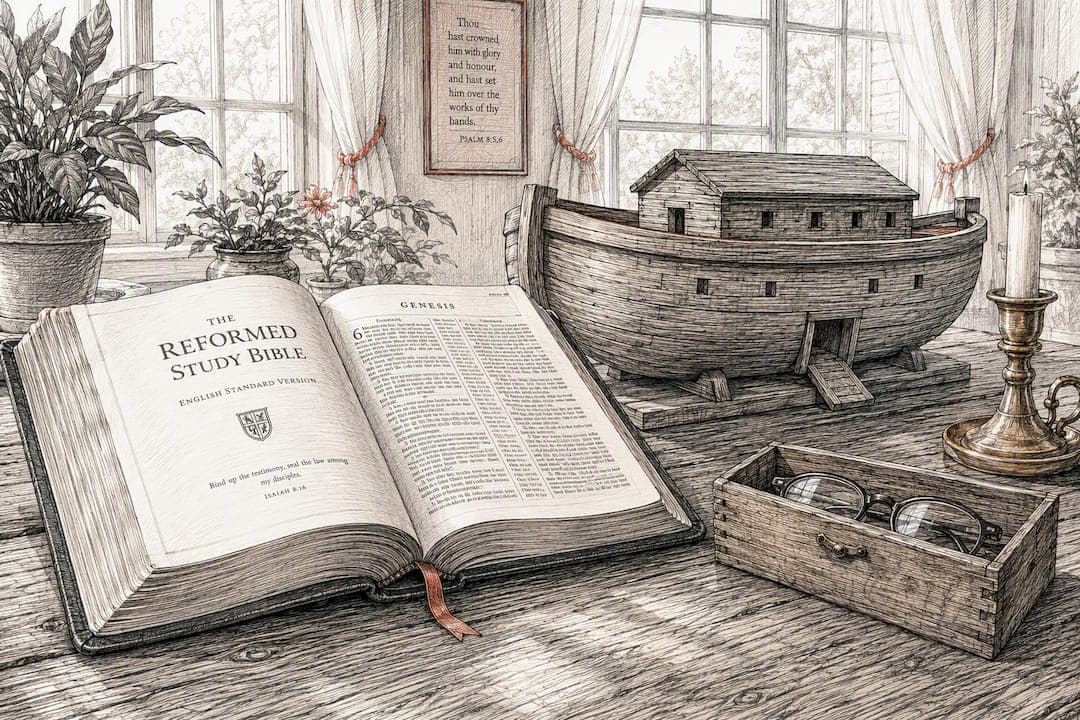
This page gives you a complete Noah's Ark lesson: objectives, a Scripture-based story script, age-adapted activities for preschool through youth, and printable resources you can use this week. It follows Genesis 6–9, keeps judgment and mercy together instead of softening one for the other, and closes with follow-up media for family devotions at home.
TL;DR:
- The lesson emphasises God's justice and mercy, highlighting that Noah was chosen by grace and obedience was essential despite the long build time.
- Teaching activities are tailored to age groups, with sensory play for preschoolers and inductive study for older students, to keep engagement and reinforce key lessons.
- The story should be presented with biblical accuracy, connecting God's judgment with His covenant faithfulness and the foreshadowing of Christ through the rainbow.
- Follow-up media resources from Bonafice Media offer additional films, printables, and podcasts for family and classroom extension, costing $4.99 monthly or $44.99 yearly.
- Key details include the ark's specific measurements and the importance of linking Noah’s obedience to God's covenant promise, avoiding oversimplified or sanitized versions of the story.
Table of Contents
- Noah's Ark Lesson: The Genesis 6–9 Story and Memory Verses
- Key Teaching Points by Age Group
- Age-Group Lesson Plans and Activities That Actually Work
- A Plug-and-Play 45 to 60 Minute Noah's Ark Lesson Plan
- Crafts, Games, and Printable Worksheets for the Classroom
- Teaching the Flood Faithfully Without Softening or Sensationalizing It
- Using Bonafice Media Resources to Extend This Lesson
- Where to Find Printables and Trusted Retellings
- Why This Lesson Refuses to Flatten the Story
- Keep the Lesson Going With Bonafice Media
- Sources
Noah's Ark Lesson: The Genesis 6–9 Story and Memory Verses
Genesis 6 opens with a hard truth: humanity's wickedness had grown so great that "the LORD was sorry that He had made man on the earth" (Genesis 6:6). But Noah "found favor in the eyes of the LORD" (Genesis 6:8), and God gave him precise building instructions rather than vague encouragement.
Genesis 6:14 through 16 records exact specifications: the ark measured 300 by 50 by 30 cubits, three decks, one door, one window. Noah obeyed without seeing a single raindrop. Genesis 7 describes the flood covering the highest mountains; Genesis 8 shows the waters receding and Noah releasing a raven, then a dove. Genesis 9 closes with God's covenant and the rainbow as its sign, tied closely to Ark Encounter's retelling of the narrative.
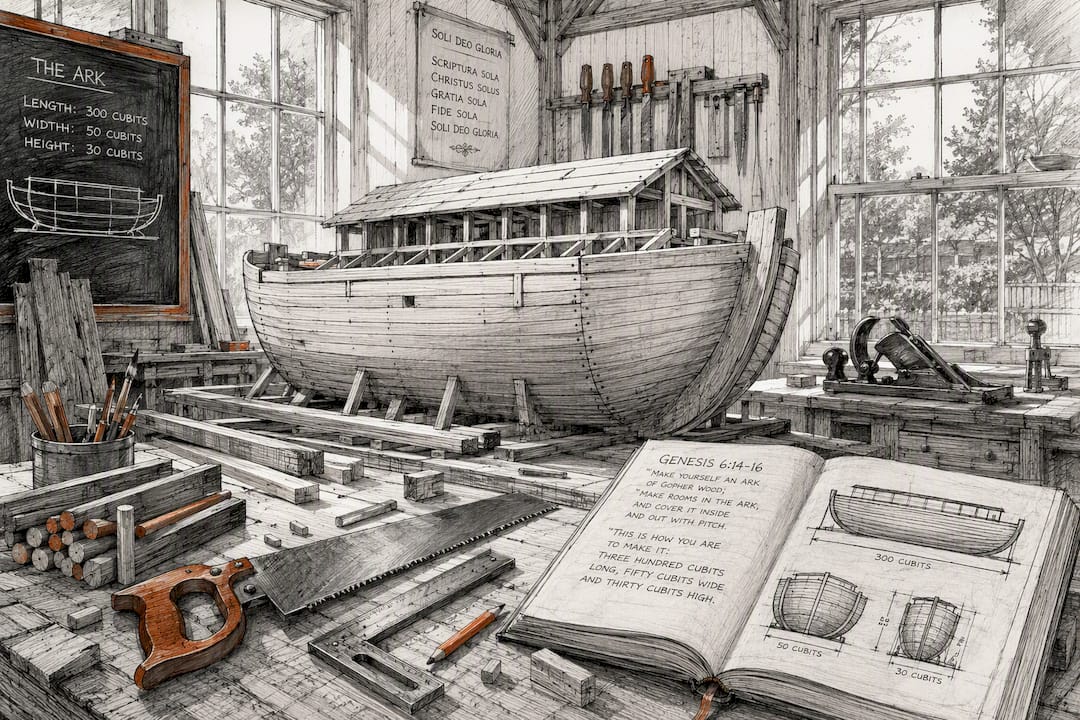
Two memory verses work well for classroom use: Genesis 6:22 ("Thus Noah did; according to all that God had commanded him, so he did") for teaching obedience, and Genesis 9:13 ("I have set My bow in the cloud, and it shall be for a sign of a covenant") for teaching God's promise. Use the LSB text for both.
Teacher script prompts to move between beats: "God saw something troubling on the earth. What was it?" ... "Now watch what Noah does next." ... "The rain has stopped. What do you think Noah is feeling?"
Key Teaching Points by Age Group
Four doctrinal threads run through this story, and each one needs different language depending on who is listening.
Obedience and faithfulness. Noah built the ark over decades before there was any visible reason to. For preschoolers, say simply: "Noah listened and obeyed, even when it was hard." For youth, push further: obedience to God's revealed word, not personal feeling, is what Genesis 6:22 commends.
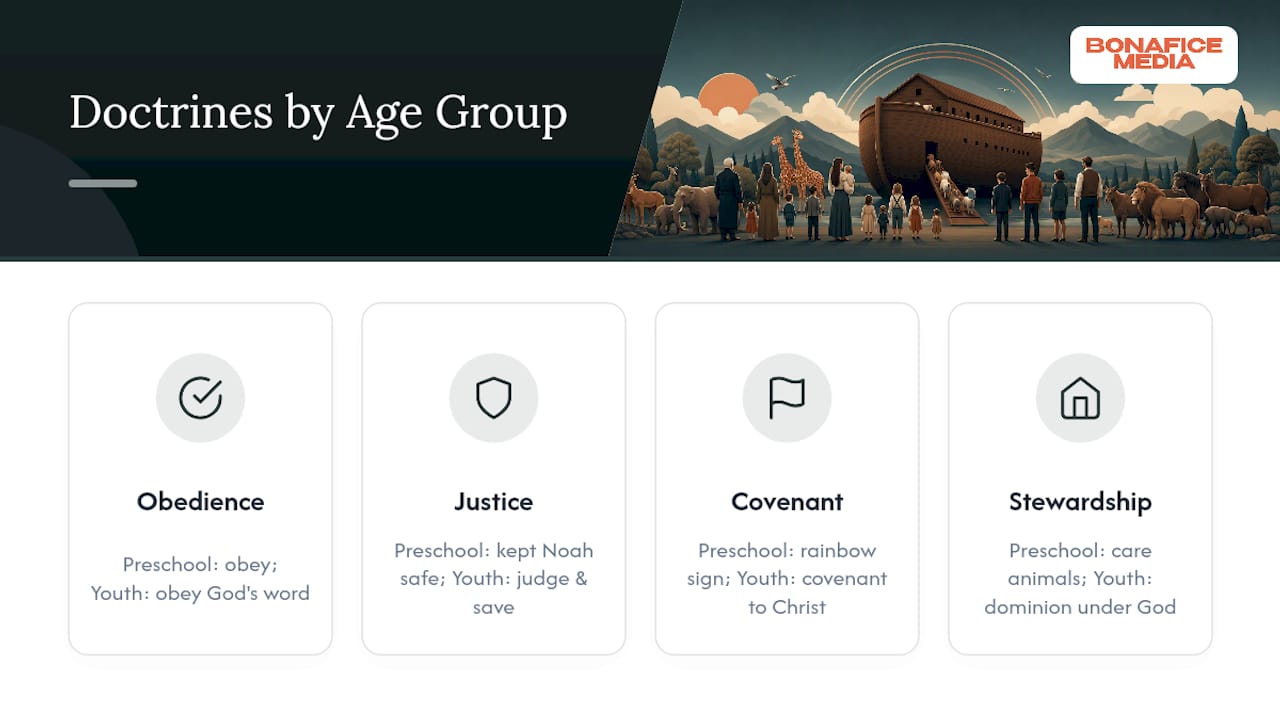
God's justice and mercy held together. Don't let one eclipse the other. Preschool line: "God is sad about sin, but He kept Noah's family safe." Youth prompt: "Why does a holy God have to judge sin, and why does He still choose to save?"
Covenant promise. The rainbow is a legal sign, not decoration. Older students should hear it as the first in a chain of covenants that runs to Christ.
Stewardship. Noah cared for the animals aboard the ark, a small but real picture of dominion under God.
A common misconception worth heading off directly: Noah wasn't sinless, he was chosen by grace (Genesis 6:8). Make that distinction plain to every age group.
Age-Group Lesson Plans and Activities That Actually Work
Run the right activity for the right age band, and this lesson holds attention start to finish.
1. Preschool (ages 3 to 5) Keep sessions short and sensory.
- Sensory bin with plastic animals and a shoebox "ark" (10 minutes)
- Simple retelling using picture cards, no reading required (5 minutes)
- Animal parade craft: paper animal masks, two-by-two lineup game (10 to 15 minutes)
- Safety note: supervise water play closely and avoid small parts for children under three
2. Early elementary (ages 6 to 9) This age group can read simple text and follow sequencing.
- Read the story aloud from a children's Bible storybook, pausing for questions
- Sequencing worksheet: put six story-event cards in correct order
- Craft: paper-plate ark with cotton-ball clouds and animal stickers
- Group discussion: "What would it feel like to wait on the ark for over a year?"
Estimated time: 20 to 30 minutes per activity block.
3. Upper elementary and youth (ages 10 and up) Move from story recall to inductive study.
- Map the ark's dimensions on graph paper using the 300 by 50 by 30 cubit measurements from Genesis 6:14 to 16
- Small-group study: read Genesis 6:5 through 8 and answer, "What does this passage teach about human sin and divine grace?"
- Discussion question: "How does the rainbow covenant point forward to Christ?"
- Application journal entry: "Where is God asking me to obey before I understand fully?"
Materials for all three bands: construction paper, cotton balls, small plastic animals, printed sequencing cards, and one storybook per small group. Total prep time runs under 30 minutes if you use the printable templates in the resources section below.
A Plug-and-Play 45 to 60 Minute Noah's Ark Lesson Plan
Learning objectives: Students will retell the flood narrative accurately, explain why Noah obeyed God, and identify the rainbow as a sign of God's covenant. Suitable for ages 5 through 14, with discussion depth adjusted per group.
Minute-by-minute timeline:
- Opening prayer and hook question (5 minutes): "Has anyone ever asked you to do something that seemed strange, but you trusted the person asking?"
- Story time (15 minutes): read or retell Genesis 6 through 9, using the script below
- Core activity (15 to 20 minutes): sequencing cards, ark-dimension mapping, or the ark craft, chosen by age band
- Application discussion (5 to 10 minutes): connect obedience and covenant to the students' own lives
- Closing prayer and memory verse recitation (5 minutes)
Leader script sample: "God told Noah to build something no one had ever built. It sounded strange. It took years. But Noah did exactly what God said, verse by verse, plank by plank. When the flood came, everyone who trusted God's warning was safe."
Assessment activity: Ask each child to state one thing Noah did and one thing God promised. For youth groups, replace this with a short written reflection connecting Noah's obedience to a modern situation requiring trust in God's word. This lesson structure mirrors the objective-driven format used in established children's ministry lesson plans.
Crafts, Games, and Printable Worksheets for the Classroom
Reproducible activities save prep time and reinforce the story without extra explanation.
- Paper-plate ark: two plates glued rim to rim, brown construction paper roof, animal stickers in pairs. Four steps, 15 minutes.
- Rocking ark puppet: cardboard ark shape on a craft-stick handle, decorated with cotton-ball waves. Five steps, 20 minutes.
- Floating zoo sensory tray: shallow bin, water, small plastic animals, a boat-shaped sponge for the ark. Works well with a kit like the AquaPets DIY craft set for preschool sensory time.
- Worksheets: sequencing cards (six to eight story events), fill-in-the-blank memory verse sheets, and a dimension-practice sheet using the ark's 300 by 50 by 30 cubit measurements for basic multiplication practice.
- Games: animal-match relay race (pairing plush or picture animals) and a memory-verse scavenger hunt around the classroom.
- Accessibility note: offer large-print cards and reduce sensory-tray noise for children with sensory sensitivities; a quiet corner with the same craft materials works as an easy alternative.
Teaching the Flood Faithfully Without Softening or Sensationalizing It
Children's Bible lessons often flatten this story into a cute animal parade and skip the judgment altogether, or they linger on the flood's destruction and skip the mercy. Neither does justice to Genesis. Present God's holiness and God's mercy in the same breath: He judged real sin, and He rescued Noah's family by grace, not merit.
Tie the story to the larger covenant arc rather than treating it as an isolated tale. The rainbow points forward through Scripture's covenant history toward Christ, which is why gospel-foreshadowing language (Noah's rescue through water, echoed later in baptism) belongs in this lesson for older students.
Sample phrasing by age: preschoolers hear "God kept His promise to Noah, and He always keeps His promises." Youth hear: "The flood shows us sin has real consequences. The ark shows us God provides a way of salvation for those who trust Him."
Pro Tip: When a child asks why God "killed everyone," don't deflect. Say plainly that sin is serious and God is just, then pivot immediately to how God provided a way of escape for those who trusted Him. That pivot is the gospel pattern the whole Bible follows.
Using Bonafice Media Resources to Extend This Lesson
A single classroom session rarely finishes the conversation, and that's where follow-up media earns its keep.
- Children's programming that reinforces the flood narrative for family viewing after class
- Short films suited to Sunday-evening follow-up discussions with older kids and youth
- Printable lesson packs and worksheet templates for classroom or co-op use
- Podcasts and teaching resources parents can use to reinforce covenant theology at home
Bonafice Media's library runs past 1,300 pieces of content, curated for households that want Christ-centered material instead of guessing what's safe on mainstream platforms. That makes it a practical fit for homeschool families who need supplemental Bible content alongside a curriculum, not just entertainment. Teachers can pull printable packs directly from the Bonafice landing page and pair them with the age-group activities above.
Where to Find Printables and Trusted Retellings
A few outside resources round out your prep without adding hours to it.
- Ministry-to-Children's Noah lesson offers a printable-ready structure and materials list for ages 5 to 12.
- Bible Fun for Kids has sequencing cards and "walk into the ark" activity ideas, including SEND-friendly adaptations.
- The Kids Bible's retelling works well as a simplified read-aloud for younger groups.
- A no-mess water art book keeps craft time tidy during worship-hour childcare.
- Quote Scripture from the LSB rather than paraphrased retellings when accuracy matters for memory work.
Why This Lesson Refuses to Flatten the Story
Most Noah's Ark curricula on the market treat this account as a nursery-friendly animal story and stop there. That approach undersells Genesis 6 through 9 badly. The text is about a holy God judging real sin and keeping a covenant promise through one obedient man's family. Teach it that way from preschool onward, in language calibrated to the age in the room, and children grow up with a true picture of God rather than a cartoon they'll need to unlearn later.
The conventional advice to "keep it simple for kids" often means removing judgment entirely. That's a mistake. Simplicity should shape vocabulary, not theology. A four-year-old can grasp "God is sad about sin but keeps His promises" without trauma, and a fourteen-year-old needs the fuller weight of covenant and judgment or the story reads as fable rather than history.
If you take one thing from this lesson pack, prioritize the connection between Noah's obedience and God's covenant faithfulness before you worry about which craft to run. The activities support the theology. They should never replace it.
— The Bonafice Media Team
Keep the Lesson Going With Bonafice Media
Bonafice Media is the fastest way to put trustworthy follow-up content in front of your students and your own family without vetting a dozen streaming platforms first. Where most children's ministry curricula leave you searching separately for printables, family films, and homeschool supplements, Bonafice Media keeps a curated library of over 1,300 Christ-centered films, kids' programs, podcasts, and teaching resources in one subscription.
Teachers can pull printable lesson packs to extend this Noah's Ark unit, and families can queue up age-appropriate children's programming for the evening after class without wondering what's hiding in the next recommended video. Subscriptions run $4.99 a month or $44.99 a year, with iOS and Android apps available now. A TV app is planned as budget allows is available, so for now stream to, your television by phone mirroring or Chromecast can be accessed through Google Chrome. Visit the Bonafice subscription page to start browsing the printable packs and children's library today.
Sources
This article was created with AI assistance under human direction and review. Bonafice Media uses AI as a tool to be faithfully stewarded, never as a substitute for human judgment, study, creativity, or responsibility. Content is reviewed for accuracy, biblical faithfulness, and clarity before publication. Scripture references use the Legacy Standard Bible as applicable. It's for general educational and informational purposes only and is not professional, legal, financial, or pastoral advice.