

The strongest New Testament movies split into two camps: word-for-word Gospel adaptations built for study, and dramatic films built for devotional impact. The Gospel of John (2003), the LUMO Project's Gospel of Mark, Pasolini's The Gospel According to) St. Matthew (1964), and Paul, Apostle of Christ (2018) cover both approaches well. Ministry distributor pages and platforms like Bonafice Media carry family-safe versions of these titles, so start there before searching general streaming services.
TL;DR:
- Word-for-word adaptations like the Gospel of John and LUMO Project films are ideal for precise biblical study but require more time and may not suit all audiences.
- Artistic reinterpretations, such as Pasolini’s Matthew, offer high fidelity with a distinct visual style but are less suitable for young children due to their pacing and language.
- Dramatized films like Paul, Apostle of Christ, focus on emotional and historical authenticity, making them better for devotional viewing and discussions on faith and perseverance.
- Availability varies across ministry sites, with curated platforms like Bonafice Media providing family-friendly, biblically faithful options in one subscription service.
- For effective teaching, select films based on purpose: literal adaptations for study and interpretive dramas for emotional engagement, avoiding using one for the role of the other.
Table of Contents
- What Makes a Good New Testament Movie for Your Family
- How to Choose a New Testament Film for Your Purpose
- Where to Watch New Testament Movies Online
- Literal Adaptations, Art-House Films, and Modern Dramas Compared
- Why Trust This List: Editorial Standards Behind Our Picks
- How These Films Shape Bible Teaching and Church Life
- How Christian Traditions View New Testament Films Differently
- Our Take on Picking the Right New Testament Film
- Watch New Testament Films Without the Streaming Guesswork
- Sources
What Makes a Good New Testament Movie for Your Family
Choosing the right film starts with knowing what job you need it to do. A movie for a Wednesday night Bible study needs different qualities than one for a family movie night during Holy Week, and conflating the two leads to disappointment either way.
Here is a ranked shortlist, moving from the most textually precise adaptations to the more interpretive dramatic films.
-
The Gospel of John (2003) — Feature film, word-for-word format. This production adapts the Good News Bible script and follows the Gospel of John precisely, rendering nearly every verse on screen with narration filling the gaps. It runs long because it refuses to compress the text.
- Best for: serious Bible study, adult small groups, catechism supplement
- Faithfulness: near word-for-word
- Note: the length rewards patience; consider watching in two sittings with children
-
The Gospel of Mark (LUMO Project) — Feature film, word-for-word format. The LUMO Project built this and its companion Gospel films directly from Scripture text, and the full film is available through ministry partner Witness21 for study and evangelism use. Mark's Gospel moves quickly, and the film matches that pace, making it a good entry point for viewers new to literal adaptations.
- Best for: study groups wanting a shorter literal adaptation than John
- Faithfulness: word-for-word, minimal added dialogue
- Note: distributed as a full standalone film rather than through mainstream streaming catalogs
-
The Gospel According to St. Matthew (1964, Pasolini) — Feature film, black and white. Director Pier Paolo Pasolini built this film to follow Matthew's Gospel closely while applying a neorealist visual style), using nonprofessional actors and stark Italian landscapes standing in for Judea. It remains one of the most critically respected Jesus films ever made, praised even by secular critics for its restraint.
- Best for: film study, older teens and adults, viewers interested in cinema history
- Faithfulness: high textual fidelity, unconventional visual presentation
- Note: subtitled Italian dialogue and austere pacing make it a poor fit for young children
-
Paul, Apostle of Christ (2018) — Feature film, dramatic interpretation. This film imagines the final days of the Apostle Paul's imprisonment in Rome, dramatizing conversations and relationships the New Testament only sketches. It leans on historical context about Nero's persecution to build tension around Luke's visits to Paul in prison.
- Best for: devotional viewing, discussion nights on suffering and perseverance
- Faithfulness: builds narrative around historical and scriptural framework, includes invented dialogue
- Note: contains intense persecution scenes; preview before showing to children under twelve
-
The Gospel of Luke (LUMO Project) — Feature film, word-for-word format. LUMO's companion film to Mark covers Luke's Gospel with the same literal-script approach, including the nativity and resurrection accounts in fuller detail than Mark provides.
- Best for: Christmas and Easter viewing tied directly to the text
- Faithfulness: word-for-word
- Note: available through the same ministry distribution channels as Mark
-
The Gospel of Matthew (LUMO Project) — Feature film, word-for-word format. This entry completes LUMO's four-Gospel set, giving study groups a literal companion to Pasolini's more artistic Matthew adaptation.
- Best for: comparing literal versus interpretive treatments of the same Gospel
- Faithfulness: word-for-word
- Note: pairs well as a follow-up screening after Pasolini's version for a discussion on adaptation choices
-
Jesus of Nazareth (1977) — Television miniseries, dramatic interpretation. Franco Zeffirelli's multipart production remains a staple for church Easter programming, blending several Gospel accounts into one continuous narrative.
- Best for: multi-night family viewing during Lent
- Faithfulness: harmonized across Gospels, moderate dramatic license
- Note: runs several hours across episodes, so plan a viewing schedule in advance
How to Choose a New Testament Film for Your Purpose
Not every occasion calls for the same movie, and picking the wrong format for the moment is the most common mistake families make. A literal adaptation dropped into a casual family night can feel like homework. A loosely interpretive drama used for serious exegesis can plant details in a child's memory that Scripture never states.
Ask these questions before you press play:
- What is the goal? Study and memorization call for word-for-word films. Emotional engagement and discussion call for dramatic films.
- How closely does it track the biblical text? Check whether the script is drawn directly from a translation or written independently around the events.
- What is the runtime and format? A three-hour word-for-word film suits a study series better than a single evening; a 90-minute drama fits a Friday movie night.
- Which translation or narration is used? Some literal films use the Good News Bible, others use different translations, and the wording will shape how closely it maps to the version your family reads.
- Are there content warnings? Crucifixion scenes, persecution violence, and demonic imagery vary widely in intensity across these films.
- Is it age-appropriate for the youngest viewer in the room? A film fine for teenagers may be too intense for children under eight.
Pro Tip: When a film is going into an actual Bible study curriculum, choose a word-for-word adaptation like the LUMO Project films rather than a dramatic interpretation. Because their scripts derive directly from a Bible translation rather than paraphrase, you reduce the risk of a group mistaking a screenwriter's invention for the biblical account.
For a Sunday school class walking through Mark, the LUMO film matches nearly verse for verse. For a family wanting a moving Good Friday experience, Paul, Apostle of Christ or Zeffirelli's miniseries will land harder emotionally, even though both add scenes the text does not describe.
Where to Watch New Testament Movies Online
Availability for these films is scattered across several kinds of sources, and no single service holds all of them.
- Ministry distributor pages carry the most reliable versions of literal adaptations. Faith Comes By Hearing partners with Bible Media Group to distribute Gospel films built directly from biblical text, often with multiple language audio tracks for international families.
- Ministry video platforms like Witness21 host full LUMO Project films for free viewing, useful when you need a specific Gospel for a study session without a subscription.
- General video platforms carry uneven and sometimes unlicensed copies of older films like Pasolini's Matthew, so verify quality and completeness before committing a class period to one.
Bonafice runs $4.99 a month or $44.99 a year, with iOS and Android apps available now. There is no dedicated TV app yet, though one is planned as the budget allows. In the meantime, stream to your television by mirroring your phone or casting through Google Chrome. Because ministry catalogs and streaming libraries both change over time, it is worth checking a distributor's page directly before scheduling a class around a specific title.
Literal Adaptations, Art-House Films, and Modern Dramas Compared
Three distinct filmmaking philosophies dominate New Testament cinema, and understanding them helps you set expectations before the opening scene.
Word-for-word adaptations treat the Gospel text as the literal screenplay. The Gospel of John and the LUMO Project films fall here, narrating Scripture directly and filling gaps only with necessary visual staging.
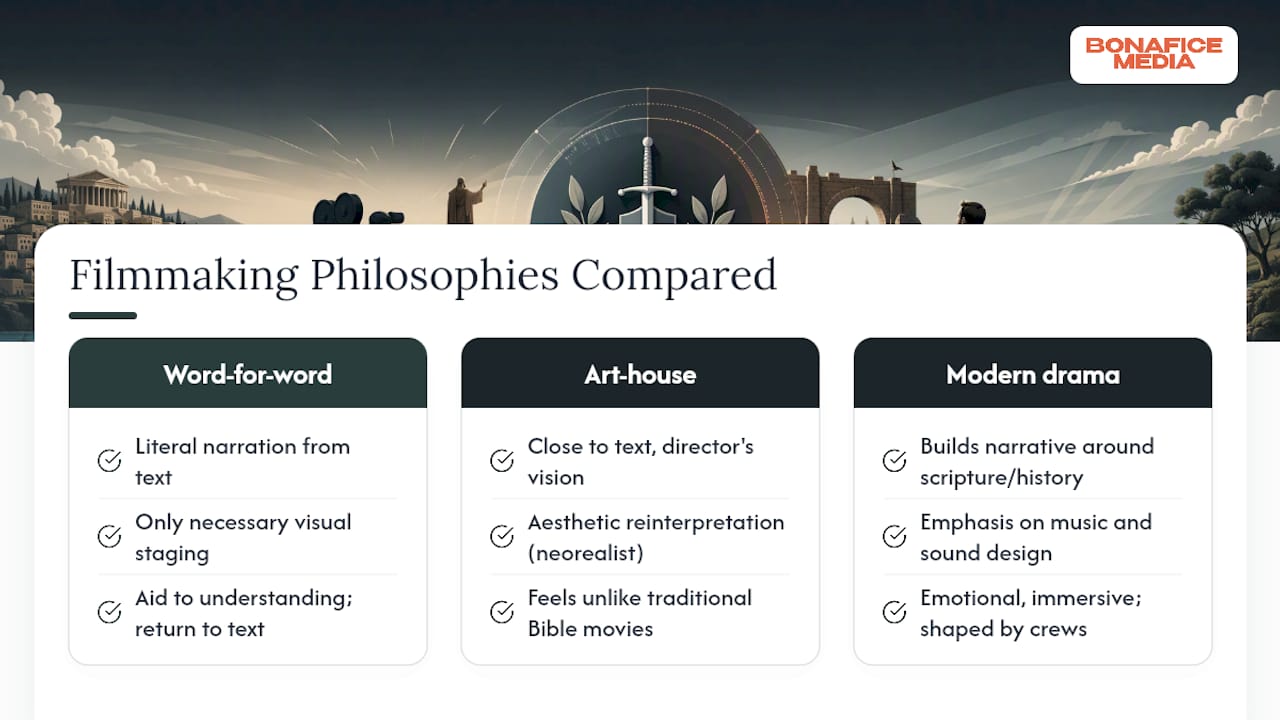
Art-house reinterpretations apply a director's aesthetic vision to a faithful textual base. Pasolini reportedly chose Matthew's Gospel because he judged its tone suited his neorealist style, producing a film that stays close to the text while looking nothing like a traditional Bible movie.
Modern devotional dramas build narrative around historical and scriptural framework rather than reciting verses. Paul, Apostle of Christ falls here, and productions like CBN's Oracles of God show how theological consultants and local crews shape these projects, sometimes filming under difficult conditions in the Holy Land itself. A look at the scoring and music choices behind spiritual cinema also shows how much emotional weight these dramas place on sound design rather than dialogue alone.
Even the most literal Gospel film cannot avoid visual choices the biblical text never specifies. Careful viewers should treat these adaptations as aids to understanding Scripture, not replacements for it, and return to the text itself for anything the film dramatizes beyond what is written.
Understanding this distinction matters most when teaching children, who often absorb a film's invented details as though they were biblical fact.
Why Trust This List: Editorial Standards Behind Our Picks
The Bonafice Media Team built this list around one standard: biblical fidelity first, family safety second, and theological alignment with confessional Reformed convictions throughout. Bonafice Media curates a library of over 1,300 theological and family-friendly items, including films and homeschool-ready educational resources, and that curation work informs which titles we recommend here.
We favor films where the source text is verifiable and the production choices are transparent, rather than movies that dramatize freely without clear sourcing. If you want to watch a recommended title tonight, subscribe through the Bonafice app on iOS or Android, then stream to your television by mirroring your phone or casting through Google Chrome until a dedicated TV app arrives.
How These Films Shape Bible Teaching and Church Life
New Testament movies do real work in classrooms and living rooms that a printed page cannot always replicate. A Sunday school teacher walking eight-year-olds through the crucifixion narrative gets more traction from twenty minutes of the LUMO Gospel of Mark than from reading the passage aloud twice.
Homeschool co-ops use these films differently than churches do. A co-op studying ancient history alongside Scripture benefits from Pasolini's stark visual world, which makes first-century Judea feel tangible rather than abstract. A youth group discussion night, by contrast, gets more mileage from Paul, Apostle of Christ, where the drama around imprisonment and doubt gives teenagers something concrete to talk about.
The risk runs the other direction too. When a congregation only ever sees one cinematic version of the Gospels, that film's specific choices, an actor's face, an invented scene, a director's pacing, can quietly become the mental default for how people picture the events. That is exactly why word-for-word adaptations matter so much for teaching contexts: they anchor the visual experience back to the actual text rather than to a screenwriter's imagination.
How Christian Traditions View New Testament Films Differently
Confessional Reformed communities generally favor films that treat Scripture as sufficient and avoid embellishments that could shade into extra-biblical tradition. That preference explains why word-for-word adaptations like the Gospel of John and LUMO Project films tend to earn more trust in Reformed circles than heavily dramatized productions.

Catholic and Orthodox audiences have historically shown more openness to devotional dramas that draw on church tradition alongside Scripture, which is part of why films with expanded portrayals of Mary or the apostles have found steady audiences in those communities. Evangelical and charismatic audiences often gravitate toward emotionally driven dramas like Paul, Apostle of Christ, valuing the film's ability to move an audience toward decision and response.
None of these differences are trivial, and they shape which films a given church will screen for a youth event versus a Wednesday Bible study. Families navigating between traditions, or homeschool co-ops drawing from multiple denominational backgrounds, do well to lean on the more textually anchored adaptations when the goal is doctrinal teaching, reserving the more interpretive dramas for discussion-based settings where the added material can be named and addressed directly.
Our Take on Picking the Right New Testament Film
Most lists of Bible movies treat faithfulness as a single sliding scale, from loose to literal, and rank everything against it. That framing misses the point. A word-for-word film and a devotional drama are not competing for the same job, and grading Paul, Apostle of Christ against the Gospel of John for textual accuracy is like grading a sermon against a Scripture reading.
The more useful question is purpose. Reformed households, in particular, should default to word-for-word adaptations whenever the goal is teaching, because a script drawn straight from the biblical text keeps the film subordinate to Scripture rather than the other way around. Save the dramatic films for what they do well: making the human stakes of persecution, doubt, and conversion feel real to a teenager who has heard the words a hundred times but never felt their weight. Choose deliberately, and the film becomes a tool for discipleship rather than a passive substitute for it.
— The Bonafice Media Team
Watch New Testament Films Without the Streaming Guesswork
Most families end up piecing together New Testament viewing from scattered ministry pages, unlicensed uploads, and mainstream services that mix faithful films with content no Christian household would choose deliberately. Bonafice Media solves that by curating a library of over 1,300 theological and family-friendly pieces of content in one place, so you are not vetting every title yourself before letting your kids press play.
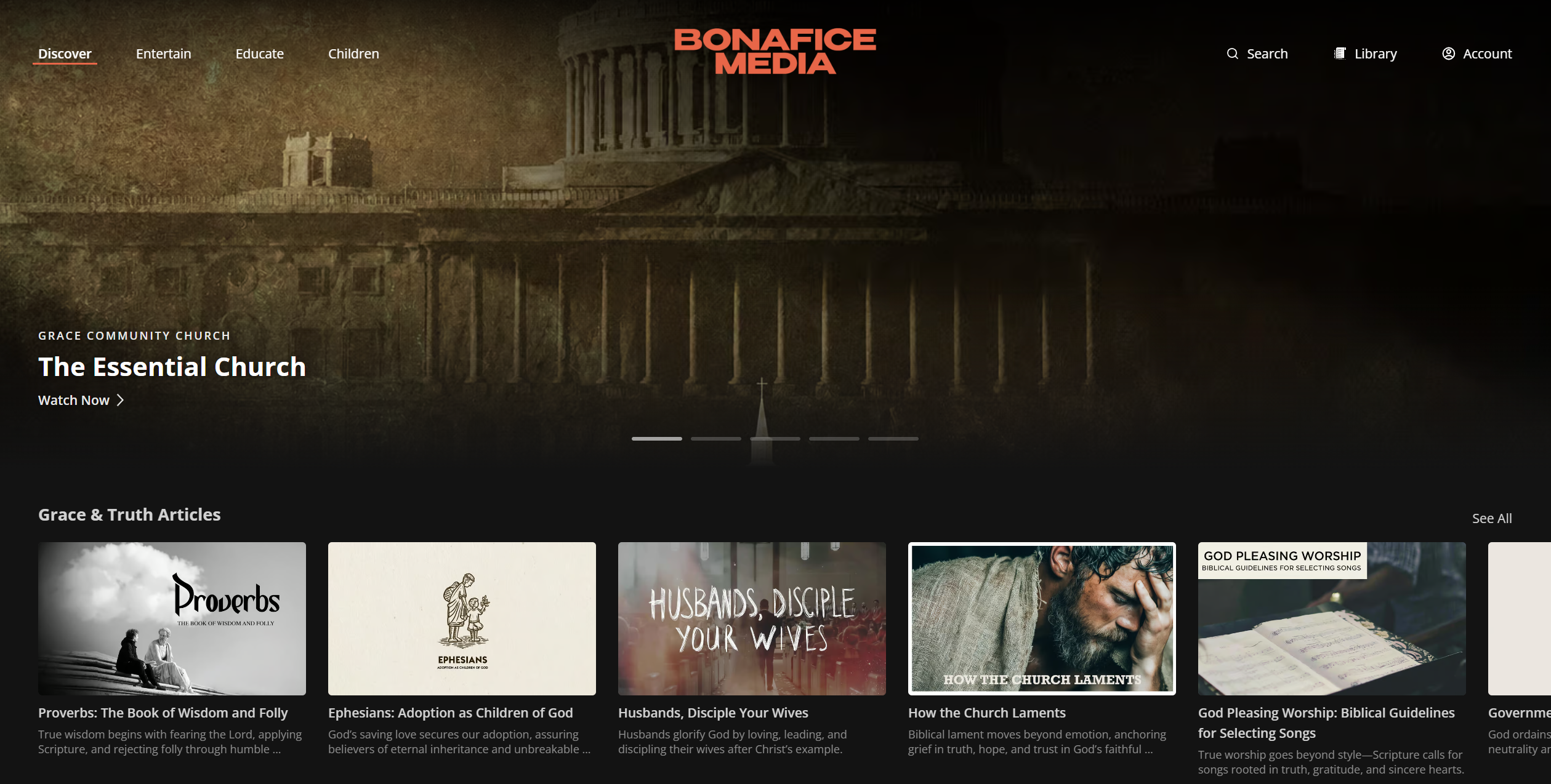
The platform fits the exact audience this list was written for: parents, homeschoolers, and church leaders who want biblical fidelity without a second screening pass. Subscriptions run $4.99 a month or $44.99 a year, with iOS and Android apps ready now. Until a dedicated TV app arrives, mirror your phone or cast through Google Chrome to watch on the big screen. Start a subscription today at App and search the library for your next family movie night pick.
Sources
- The Gospel of Mark | Full Movie | LUMO Project | Word-for-Word Bible Film ‣ Witness21
- Gospel Films - Faith Comes By Hearing
- Behind the scenes of CBN's 'Oracles of God' and New Testament production
This article was created with AI assistance under human direction and review. Bonafice Media uses AI as a tool to be faithfully stewarded, never as a substitute for human judgment, study, creativity, or responsibility. Content is reviewed for accuracy, biblical faithfulness, and clarity before publication. Scripture references use the Legacy Standard Bible as applicable. It's for general educational and informational purposes only and is not professional, legal, financial, or pastoral advice.