

The fastest way to start mother daughter devotions tonight is a 5-day plan: one verse, a 2 to 3 sentence reflection, one discussion question, and a short closing prayer or activity. You do not need a curriculum or a special occasion. You need ten minutes, a Bible, and a willingness to ask your daughter a real question and wait for a real answer.
Start with these three steps:
-
Pick one verse from the LSB that speaks to something happening in your daughter’s life right now.
-
Set a fixed time, even if it is just before bed or over breakfast on Saturday.
-
Gather a Bible and a journal so she can write down what she hears from Scripture and from you.
If you want a ready-made library to pull from once this habit sticks, Bonafice Media curates teaching resources built for exactly this kind of family discipleship.
Key Takeaways
Mother daughter devotions succeed when mothers use a short, reproducible structure of Scripture, reflection, one question, and prayer rather than a long, complicated lesson plan.
| Point | Details |
|---|---|
| Start with 5 days | A short trial plan reveals your daughter’s attention span before you commit to a longer devotional. |
| Match format to season | Use 5 to 7 day plans for busy weeks, 21 to 40 day plans for focused topics, and 40 to 52 week plans as keepsakes. |
| Adjust by age | Elementary daughters need stories and crafts, tweens need journaling, and teens need honest, deeper questions. |
| Protect the first five minutes | A fixed calendar slot keeps devotion time from getting pushed aside by homework or practice. |
| Add supplements sparingly | A journal, a hymn, or a short Bonafice clip should support the Scripture passage, not replace it. |
Table of Contents
-
How Do You Get Honest, Meaningful Answers From Your Daughter?
-
What Journals, Music, or Media Should You Add to Devotion Time?
What Are the Best Mother Daughter Devotional Formats?
Not every season of your daughter’s life calls for the same kind of devotional. A first grader and a high school junior need different structures, and so does a mom who has never done this before versus one who has run family worship for a decade.
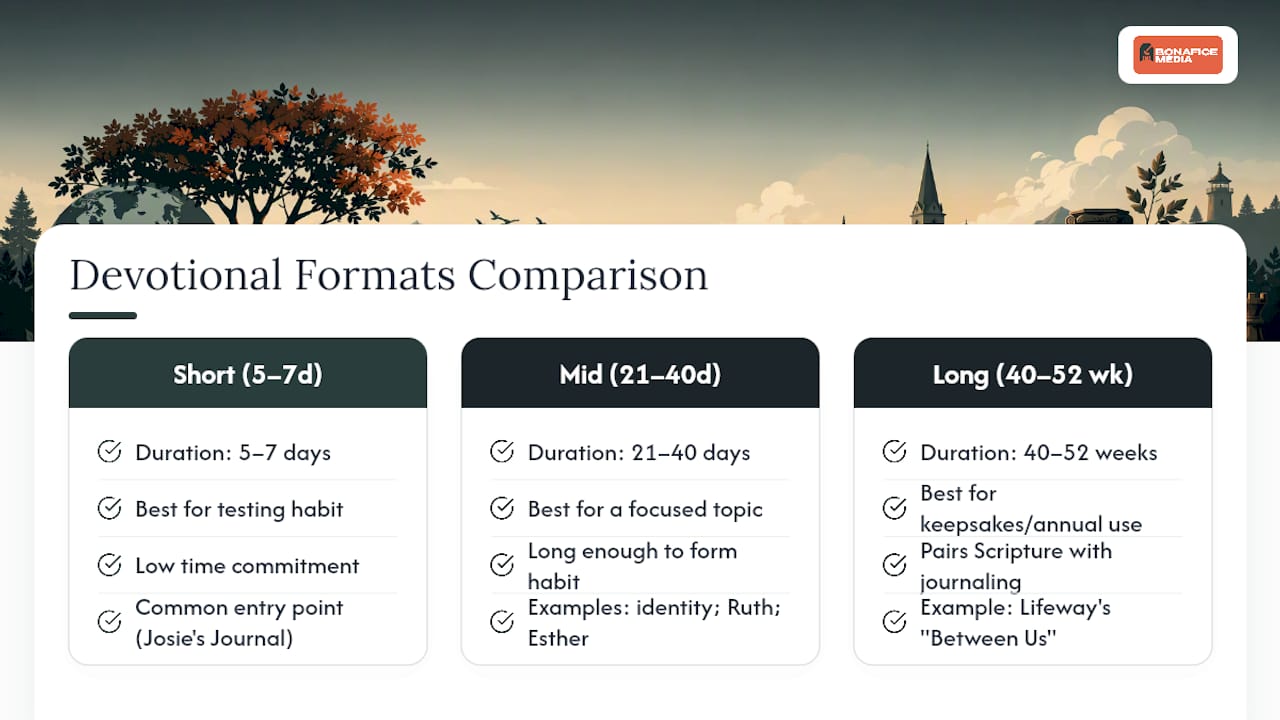
Short series (5 to 7 days) work best when you are testing the habit for the first time, traveling, or easing back into a rhythm after a busy season. They ask for almost nothing and deliver a complete experience. This is also the format Josie’s Journal points to as the common entry point moms use before committing to something longer.
Mid-length plans (21 to 40 days) suit a focused topic, like identity in Christ or studying women of the Bible such as Ruth or Esther. Forty days is long enough to form a real habit but short enough that it will not collapse under a busy month.
Long-term weekly keepsakes (40 to 52 weeks) turn into something your daughter keeps. A year-long devotional like Lifeway’s “Between Us” pairs Scripture with journaling prompts she can look back on at sixteen, or twenty-six.
Choose an activity-driven study, something closer to DUOble Faith’s craft-and-conversation model, when your daughter is younger and needs her hands busy while her heart listens. Choose a simple read-and-discuss format when she is older and can sit with a passage without a project attached to it.
Pro Tip: If you are not sure which format fits, start with a 5-day plan before buying anything longer. You will learn more about your daughter’s attention span and honesty level in five days than any product description will tell you.
How Do You Actually Run a Mother Daughter Devotion?
Consistency beats intensity. A rushed 30-minute devotion twice a month teaches your daughter less than a calm 10-minute devotion every week.
-
Set the cadence first. Daily works for younger children who thrive on repetition. Weekly works better for tweens and teens juggling school and activities. First5 has built an entire ministry around the idea that short, daily Scripture rhythms outperform occasional long ones for busy households.
-
Decide who reads and who asks. Alternate reading the passage aloud. You ask the questions, but resist the urge to lead her to your answer. Ask “What stood out to you?” instead of “Don’t you think this means…?”
-
Journal, even briefly. A single sentence in a notebook after each devotion gives her a written record of her own spiritual growth, not just yours.
-
Add a short Bonafice clip or song when it fits. A five-minute teaching video or hymn can open a conversation your daughter would not start on her own.
-
Put it on the calendar. A recurring event on your phone protects this time the same way it protects a dentist appointment.
Pro Tip: Guard the first five minutes like it is sacred, because it usually is the hardest part. Once you are both sitting down with Bibles open, momentum carries you the rest of the way.
Your supply list stays simple: an LSB Bible, a journal, two pens, and nothing else you cannot carry to a coffee shop.

How Should You Adjust Devotions by Your Daughter’s Age?
Scripture does not change, but how you deliver it should. A devotion that lands with a seven-year-old will bore a fifteen-year-old, and vice versa.
-
Elementary (ages 5 to 10): Keep it story-driven with one memory verse per week. Add a hands-on activity, a simple craft or a DUOble-style prompt, and let her watch you pray out loud so she learns the pattern. Try: “What did God ask Noah to do, and why do you think Noah obeyed even when it seemed strange?”
-
Tween (ages 11 to 13): Anchor devotions in identity and friendship. Give her a journaling prompt instead of just a question, and let the reflection run a little longer. Try: “Read Psalm 139:13 to 14. Write one thing about yourself you have struggled to believe God made well.”
-
Teen (ages 14 to 18): Ask harder Scripture questions and leave real room for honest, even skeptical, answers. Practice silent prayer together and talk through one concrete way to apply the passage that week. Try: “Read Romans 12:2. Where in your life this week did the world’s pattern pull harder than God’s Word?”
The Proverbs 31 Ministries model of gentle, heart-level conversation works across all three stages. The tone stays soft even as the content deepens.
A 5-Day Mother Daughter Devotional You Can Start Tonight
Here is a complete plan built on the passage, reflection, question, and prayer structure that PrayersFor.com uses for short mother daughter devotions.
-
Day 1, Psalm 139:13 to 14. God formed your daughter with intention, not by accident. Ask: “What is one thing about how God made you that you want to thank Him for?” Close with a one-line prayer of thanks.
-
Day 2, Proverbs 31:25. Strength and dignity are things a woman puts on, not traits she is born already possessing. Ask: “What is one hard thing you handled with strength this week?” Activity: write that moment in the journal.
-
Day 3, Ruth 1:16. Ruth’s loyalty to Naomi models covenant faithfulness even when it costs something. Ask: “Who in your life do you need to be more loyal to right now?” Pray together for that person by name.
-
Day 4, Philippians 4:8. What you dwell on shapes what you become. Ask: “What is one thing you have been dwelling on that you need to bring to God instead?” Close in five minutes of quiet, silent prayer.
-
Day 5, 1 Samuel 16:7. God looks at the heart, not the outward appearance. Ask: “What is one way you want your heart to look more like Christ’s this year?” Activity: write a short prayer of commitment together.
Read and discuss each day in 10 to 15 minutes, or slow the whole plan down and cover one entry per week with extra journaling time. A 52-week free framework built on this same passage-reflection-question-prayer pattern shows how five days like this can stretch into a full year without losing shape. If you have daughters of different ages doing this together, let the older one answer first and the younger one add her own thought after.
Why Trust This Guide on Mother Daughter Devotions
Bonafice Media built this guide around a Scripture-first, Reformed conviction: family discipleship should be reproducible, not dependent on a mom’s creativity or a curriculum’s marketing. Everything here rests on the pattern Scripture itself models, parents teaching children “when you sit in your house and when you walk on the road” (Deuteronomy 6:7).
Bonafice Media’s library carries over 1,300 curated, Christ-centered pieces of content, including teaching resources families can use to supplement devotion time. A five to seven minute clip followed by one discussion question can open a conversation a printed page sometimes cannot.
A short devotional habit, repeated weekly with an open Bible and one honest question, does more for a daughter’s faith than an elaborate program she experiences twice and abandons.
Author credentials and specific case studies from Bonafice Media families will be added to future updates of this guide as they become available.
What Gets in the Way of Mother Daughter Devotion Time?
The most common obstacle is not theological confusion. It is scheduling. Evenings fill up with homework, practice, and screens, and devotion time gets pushed to “tomorrow” until tomorrow never comes. The fix is not more willpower. It is a fixed slot on the calendar that survives a bad week, even if that slot shrinks to five minutes.
A second obstacle: silence. Some daughters, especially tweens, answer every question with a shrug. Do not fill that silence for her. Rephrase the question once, then wait. A slower answer that comes from her own thinking is worth more than a quick answer you supplied.
A third obstacle is comparison. Mothers see a friend’s daughter journaling pages of reflection and assume their own daughter’s one-sentence answers mean the devotion failed. It does not. Depth grows over months, not days.
Finally, resistance from an older daughter is common and should not be treated as rebellion against God. Sometimes it is simply resistance to feeling managed. Frame the time as conversation, not correction, and let her ask you questions too. A devotion where only mom teaches and daughter listens rarely lasts past a few weeks.
How Do You Get Honest, Meaningful Answers From Your Daughter?
Open-ended questions get you further than yes-or-no questions ever will. Instead of “Do you believe God loves you?” ask “What is one moment this week you felt far from God, and why?” The second question assumes she has a real inner life worth exploring, and she will usually rise to meet that assumption.
Resist correcting her theology mid-sentence. Let her finish a thought, even an imperfect one, before you respond with Scripture. A daughter who feels edited every time she speaks stops speaking.
Share something honest from your own week before you ask her to share. Vulnerability from mom first tends to lower the guard faster than any question technique. If you admit a struggle with patience or doubt, she is far more likely to admit her own.
Keep eye contact and put your phone away, fully, not face down on the table. Ten minutes of undistracted attention communicates more than the content of the devotion itself. The Proverbs 31 Ministries approach to gentle, heart-level conversation works because it treats the daughter’s heart as worth slowing down for, not as a box to check before bed.
What Journals, Music, or Media Should You Add to Devotion Time?
A simple journal is the single best investment you can make beyond the Bible itself. It does not need to be elaborate. A daughter who writes even one sentence a week after her devotion builds a record of her own spiritual growth that she will treasure later, the same idea behind year-long keepsake formats like Lifeway’s “Between Us.”
Hymns and Psalms set to music give your daughter language for worship she has not developed on her own yet. Playing a hymn before or after your devotion, rather than during, keeps her attention on the words rather than treating it as background noise.
Short curated video teaching, five to seven minutes, can introduce a topic your devotion will unpack. Bonafice Media’s library offers this kind of supplementary content for families who want a visual or narrative hook before opening Scripture together.
Keep any supplementary resource in a supporting role. The Bible passage is the anchor. Everything else, journal, hymn, or clip, exists to help your daughter engage with that passage more deeply, not to replace it.
Ready to Deepen Your Family’s Devotional Life?
Once the 5-day plan above becomes a habit, Bonafice Media gives you a place to keep going. The Bonafice streaming platform offers a growing library of Christ-centered teaching, children’s programming, and family resources built for households that want doctrinally sound content in one place, without the guesswork of mainstream streaming. Subscriptions run $4.99 a month or $44.99 a year, and the service is available now on iOS and Android. There is no dedicated TV app yet, one is planned as budget allows, so for now you can stream to your television by mirroring your phone or casting through Google Chrome. Explore the library and find a short clip that pairs naturally with your next devotion.
An Editorial Take on What Actually Works
Most advice on mother daughter devotions overpromises. It sells elaborate coaching programs or seasonal themes when what most families actually need is a reproducible habit built on Scripture itself, not a personality-driven method that collapses the moment the mom’s energy dips.
The research behind this guide points to one consistent truth: short, repeated exposure to God’s Word, paired with honest conversation, builds more lasting faith than any single dramatic devotional experience. Conventional advice often treats the activity, the craft, the journal, the clip, as the point. It is not. Those are tools that serve the passage, never the reverse.
Mothers should prioritize consistency over polish. A five-minute devotion done weekly for a year outperforms an ambitious 90-day program abandoned in week three. Pick a simple format, protect the time on the calendar, and let Scripture itself do the work it was always meant to do in a daughter’s heart.
— The Bonafice Media Team
Sources
-
Be Gentle with Your Daughter’s Heart | Proverbs 31 Ministries
-
52 Weekly Free Mother-Daughter Devotionals 2025 - Josie’s Journal
This article was created with AI assistance under human direction and review. Bonafice Media uses AI as a tool to be faithfully stewarded, never as a substitute for human judgment, study, creativity, or responsibility. Content is reviewed for accuracy, biblical faithfulness, and clarity before publication. Scripture references use the Legacy Standard Bible as applicable. It’s for general educational and informational purposes only and is not professional, legal, financial, or pastoral advice.