

Yes, faith-centered romance movies exist in real numbers, and a curated list of them follows below. These picks emphasize explicit faith practice, biblically grounded relationships, and family suitability rather than a vague “clean” label. Bonafice Media has vetted selections available in its library for households that want certainty before pressing play.
TL;DR:
Faith-centered romance movies often emphasize prayer, repentance, and biblical values rather than just avoiding objectionable content.
Content for family viewing typically involves themes of redemption, church involvement, and biblical courtship, with careful consideration of maturity levels.
Bonafice Media’s curated library ensures all titles are vetted for theological accuracy, biblical worldview, and age-appropriate content.
The genre has evolved from low-budget, niche productions to wider theatrical releases, notably since the success of films like Fireproof in 2008.
Explicit faith practice and character transformation driven by grace are stronger indicators of a film’s biblical faithfulness than marketing labels or superficial “clean” ratings.
Table of Contents
-
Historical Context and Development of Christian Romance Movies
-
Notable Directors and Actors Known for Christian Romance Films
-
Impact of Christian Romance Movies on Audiences and Faith Communities
-
Differences Between Christian Romance Movies and Mainstream Romance Films
-
Why Gospel-Centered Love Stories Matter More Than Clean Content
Best Christian Romance Movies by Viewing Occasion
Not every romance fits every household moment. A date-night pick with mild thematic weight isn’t the same as a family-friendly Friday night movie, and an old-fashioned courtship drama serves a different purpose than a true-story testimony of redemption. The list below sorts commonly recommended Christian romance movies into practical categories so you can choose quickly instead of guessing.
For Date Night
-
Fireproof (2008) — A firefighter’s marriage is falling apart until he takes on “The Love Dare,” a challenging journey rooted in Scripture. The faith element isn’t decorative here; prayer and repentance drive the plot. Advisory: some intense marital conflict and a subplot involving online pornography addiction, handled without graphic depiction.
-
A Walk to Remember (2002) — A rebellious teen falls for a pastor’s daughter who is quietly facing a severe illness. Faith surfaces through her father’s counsel and her own convictions about waiting for marriage. Advisory: mild teen partying and underage drinking in early scenes, though the arc moves toward maturity.
-
Old Fashioned (2014) — A former party-circuit womanizer now runs his life by strict courtship rules, which collide with a free-spirited new neighbor. The film wrestles openly with what biblical courtship should look like rather than assuming the audience already agrees. Advisory: frank discussion of the male lead’s sexual past, though nothing is shown.
Old-Fashioned and Traditional Courtship Stories
-
Redeeming Love (2022) — A loose adaptation of the book of Hosea set in Gold Rush California, following a man who marries a woman trapped in prostitution. The redemption arc is unmistakable and deliberately biblical. Advisory: mature themes involving abuse and trafficking make this one for older teens and adults, not young children.
-
Love’s Long Journey — Part of a broader frontier romance series, this entry follows a young couple building a marriage on the prairie under real hardship. Faith appears through household prayer and reliance on providence rather than sentiment. Advisory: mild peril from frontier dangers, nothing graphic.
-
The Love Comes Softly Series — Multiple entries follow pioneer women who lose husbands and rebuild through remarriage and community faith. Church attendance, prayer, and biblical parenting are woven through rather than tacked on. Advisory: themes of grief and loss may need context for younger viewers.
True-Story Romances
-
Beyond the Mask — An 18th-century assassin seeks redemption and a second chance at love after abandoning a life of violence for the Crown. While not a documented true story, it draws on real Revolutionary-era tension and treats repentance as central to the romance. Advisory: sword fighting and period violence, mild for the genre.
-
October Baby — A young woman who survived a failed abortion tracks down her birth mother while processing questions about identity, forgiveness, and a budding relationship along the way. The romantic subplot is secondary to the redemption story but reinforces it. Advisory: heavy themes around abortion; best for teens and up with parental discussion.
-
I Can Only Imagine — Based on the true story behind the MercyMe song, this film follows a young man’s troubled relationship with his father and his growing romance, both reshaped by forgiveness. Advisory: depictions of childhood abuse are present but not graphic.
Family-Friendly and Seasonal Picks
-
A Royal Christmas Hope — A light holiday romance where faith and family duty intersect with royal obligation. Reviewers note the film keeps thematic weight mild, which makes it a reliable pick for family movie night when you want warmth without heavier content.
-
Love in Storytown — Set in a small Christian bookstore, this film includes explicit prayer scenes and a clearly stated Christian moral worldview, which Movieguide’s detailed review highlights as a strength for families wanting faith made visible rather than implied.
-
Love Finds You in Sugarcreek — An Amish-set romance exploring plain community life, courtship customs, and forgiveness after tragedy. Advisory: gentle throughout; appropriate for most ages including younger children with some patience for a slower pace.
-
The Ultimate Gift — Less a romance than a family drama with a romantic subplot, this film follows a wealthy young man completing a series of character-building tasks left by his grandfather, one of which reshapes his view of love and generosity. Advisory: minimal concerns; suitable for most family audiences.
-
Someone Like You — A young woman navigates grief, purpose, and a slow-building romance after loss. Reviewers have noted the film can feel formulaic when faith serves as backdrop rather than active practice, a useful reminder that not every “clean” film carries theological weight. Advisory: mild thematic sadness around grief.
-
Return to Christmas — A widowed father and a woman rebuilding her own life find unexpected common ground during the holidays, with church community playing a visible role. Advisory: light and appropriate for nearly all ages.
-
Letters to God — A young boy battling cancer writes letters to God that a mail carrier ends up reading, indirectly shaping a romance between two adults in his life. Advisory: emotional content around childhood illness; parents of younger children may want to preview first.
-
The Grace Card — A police officer’s grief and anger over his son’s death threaten his marriage until a colleague’s persistent faith and forgiveness begin to change him. Advisory: some intense scenes involving grief and racial tension, best for teens and adults.
-
Where the Heart Leads — A woman returns to her small hometown and reconnects with a childhood friend while wrestling with questions about calling and faith. Advisory: minimal concerns; a gentle, low-intensity option.
For a quicker snapshot of viewing weight, here’s how these categories generally compare:
| Category | Typical Advisory Level | Best For |
|---|---|---|
| Date night picks | Mild to moderate themes | Couples, older teens |
| Old-fashioned courtship | Mild, occasional mature discussion | Families with teens |
| True-story romances | Moderate to heavier themes | Older teens and adults |
| Family-friendly and seasonal | Minimal to mild | All ages, group viewing |
How to Choose a Christian Romance Movie for Your Household
A movie can remove every curse word and still miss the gospel entirely. “Clean” measures absence; biblical faithfulness measures presence, whether prayer, repentance, and grace actually shape the story rather than decorating it. Before you press play, run through a short checklist covering theological content and family suitability together, since one without the other leaves gaps.
Look for these markers:
-
Theological depth: Does the film show characters actually praying, repenting, or seeking forgiveness, or does faith stay in the background as scenery?
-
Explicit faith practice: Church attendance, Scripture references, and household prayer are stronger signals than a character simply saying they “believe in God.”
-
Sexual content: Even implied content or repeated innuendo matters for younger viewers; check specifics rather than trusting a genre label.
-
Language: Some films marketed as faith-based still include crude language in secondary characters.
-
Violence and substance issues: Frontier and historical romances sometimes include period violence; true-story films may reference addiction or abuse.
-
Age-appropriateness: A film built for teens (grief, trafficking recovery, terminal illness) rarely suits a family movie night with young children.
Reviewers who track this genre closely note that the strongest films show characters practicing faith rather than referencing it, which is a more reliable signal than a “faith-based” marketing tag on a poster.
Pro Tip: Preview the first ten minutes of any unfamiliar title yourself before showing it to your family. Ten minutes almost always reveals whether faith drives the plot or just decorates it, and it takes less time than researching content guides after the fact.
Cross-checking with a family-review outlet like Movieguide or Dove.org adds a second layer of confidence, especially for newer releases you haven’t seen discussed elsewhere.
How Bonafice Media Vets Christian Romance Films
Bonafice Media’s library runs past 1,300 pieces of content, and every romance title goes through a theological review before it’s added, not just a content-safety scan. That distinction matters because a film can be free of profanity and still promote a worldview no Reformed household would want in their living room, from prosperity-gospel messaging to vague, syncretistic spirituality.
The curation process checks for:
-
Adherence to Hays Code Standards: Films and television programs should substantially align with the moral standards established by the historic Hays Code, particularly its emphasis on decency, restraint, respect for marriage and family, and the avoidance of glamorizing immorality.
-
No Second Commandment Violations: Content should avoid visual portrayals of Jesus Christ or the Triune God in keeping with the historic Reformed understanding of the Second Commandment.
-
No Nudity or Sexualized Content: Nudity, explicit sexual content, pornography, sexually provocative imagery, and the eroticization of characters are unacceptable.
-
Minimal to No Vulgarity: Content should avoid obscene language, vulgarity, crude joking, sexually explicit dialogue, and unnecessary profanity.
-
A Biblically Consistent Moral Framework: Stories should not require viewers to celebrate what Scripture identifies as sinful. The narrative’s moral framework should ultimately affirm or remain compatible with biblical standards of righteousness, responsibility, repentance, justice, mercy, and restoration.
-
Redemptive Storytelling: Preference should be given to stories containing meaningful themes of redemption, repentance, reconciliation, sacrifice, courage, faithfulness, perseverance, forgiveness, or the consequences of wrongdoing.
-
Healthy Portrayals of Marriage and Family: Preference should be given to content that honors marriage, family, parenthood, fidelity, and generational responsibility rather than treating these institutions with contempt.
-
Examples of Biblical Marriage and Relationships: When marriage and family relationships are central to the story, preference should be given to portrayals compatible with biblical patriarchy, marital fidelity, sacrificial leadership, respect, responsibility, and enduring covenant commitment.
-
Examples of Moral Consequences and Redemptive Arcs: Characters may sin, fail, or behave immorally—the mere depiction of sin does not automatically disqualify a work. However, serious wrongdoing should not be gratuitously celebrated, normalized, or presented as morally virtuous. Preference is given to narratives in which actions have meaningful consequences and genuine redemption is possible.
-
Suitability for Christian Homes: The overall work should be something Bonafice Media can responsibly place before Christian individuals and families without undermining the theological, moral, and family-centered purpose of the platform.
Finding titles inside the app takes seconds using tag-based search, and every romance selection includes a short content note before you commit to watching. Bonafice runs on iOS and Android, with mirroring or Chromecast support for viewing on a television screen. A dedicated TV app is in development. Curated libraries like this exist precisely because mainstream streaming search results leave families guessing.
Historical Context and Development of Christian Romance Movies
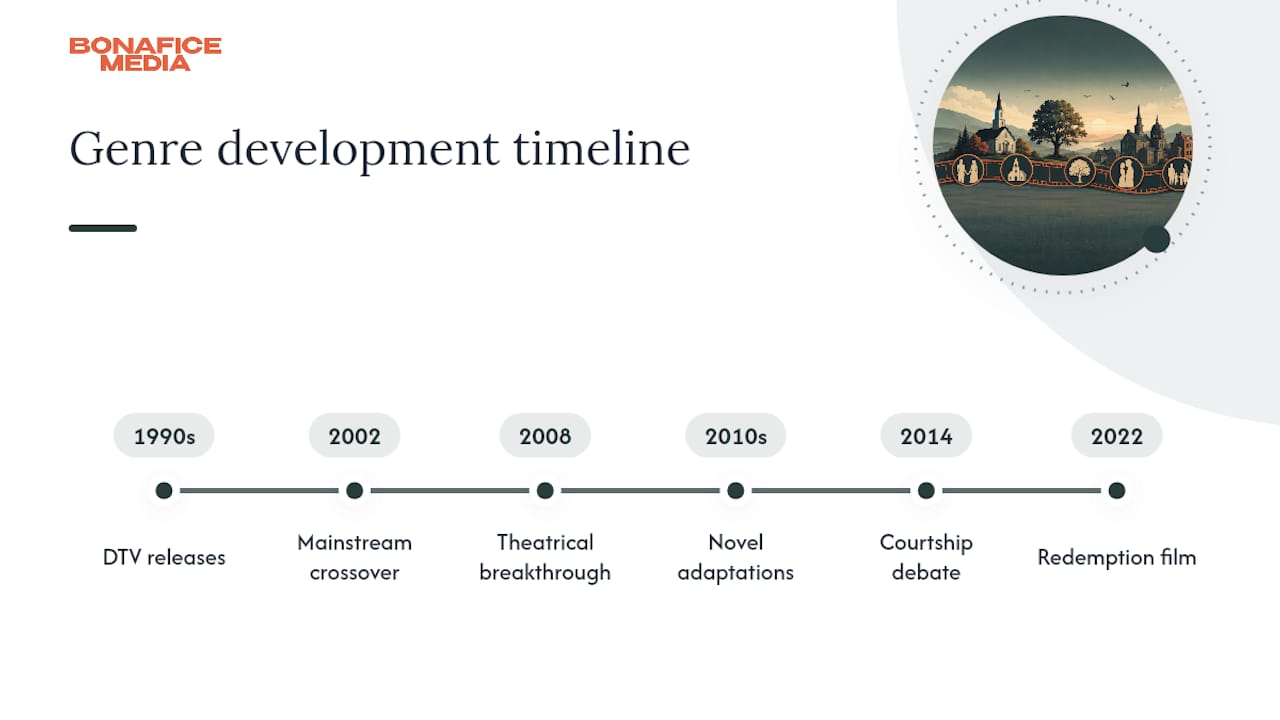
Faith-based romance as its own recognizable category is relatively young. Small production houses built the genre through direct-to-video and church-circuit releases in the 1990s and early 2000s, well before it had shelf space at general retailers. Fireproof, released in 2008, marked a turning point: a low-budget film from Sherwood Pictures that outperformed expectations at the box office and proved a theatrical audience existed for explicitly Christian marriage and romance stories.
A Walk to Remember, released earlier in 2002, took a different path by working through mainstream studio distribution while still centering a pastor’s daughter’s convictions about faith and purity. Its crossover success showed faith themes could reach general audiences without stripping out the theology.
The 2010s brought a wave of adaptations from Christian romance novelists, particularly frontier and pioneer-era stories built around courtship, providence, and rebuilding after loss. Old Fashioned, released in 2014, pushed the genre further by making courtship itself the subject of debate rather than an assumed backdrop. More recently, Redeeming Love (2022) signaled a willingness to tackle heavier redemption arcs, adapting Francine Rivers’s Hosea-based novel for a theatrical release rather than a direct-to-video one. The genre has moved from niche and low-budget toward wider distribution, though budget and production quality still vary widely from title to title.
Notable Directors and Actors Known for Christian Romance Films
Alex Kendrick and Stephen Kendrick, working through Sherwood Pictures, directed Fireproof and helped establish the template many later faith-based romances still follow: a marriage or courtship crisis resolved through a concrete faith practice rather than a vague spiritual awakening. Their films tend to treat repentance as an action, not a feeling.
Adam Watstein directed Old Fashioned, which he also wrote and starred in alongside Elizabeth Roberts, giving the film a personal stake in its argument about courtship ethics that studio-assigned directors rarely bring.
On the acting side, Kirk Cameron’s role in Fireproof remains one of the genre’s most recognized performances, largely because his character’s arc through “The Love Dare” gave audiences a concrete, repeatable model rather than an abstract message. Mandy Moore’s lead performance in A Walk to Remember introduced faith-centered romance to a broader teen audience that might never have sought out a specifically Christian film.
Abigail Cowen took on the lead in Redeeming Love, a demanding role given the film’s heavier subject matter around trafficking and abuse, requiring a performance that carried both romantic and redemptive weight simultaneously. Production companies like Pure Flix and Sherwood Pictures continue to serve as reliable sources for new entries in the genre, even as quality and theological depth still vary by individual project.
Common Themes and Motifs in Christian Romance Storytelling
Prayer as an active plot device shows up across nearly every well-regarded title in this genre, not as a passive gesture but as a turning point where a character’s decision actually changes. In Fireproof, the “Love Dare” itself functions as a structured prayer and repentance exercise built into the plot’s mechanics.
Redemption and repentance arcs appear almost universally, often paired with a character’s troubled past: addiction, a broken marriage, a history of using people, or a criminal record. The romance rarely resolves until the repentance does, which is a structural choice, not an accident. Waiting and biblical courtship recur constantly too, whether framed as literal courtship rules in Old Fashioned or as a teenager’s conviction about purity in A Walk to Remember.
Providence and God’s timing function as a recurring explanation for why two characters meet at all, especially in frontier and pioneer settings where hardship and loss set up the romance rather than undercut it. Community and church involvement typically surround the central couple, reinforcing that Christian marriage isn’t a private arrangement but a public commitment witnessed by others. Analysts studying the genre note that films integrating genuine spiritual growth alongside the romance tend to land more effectively with Christian audiences than films that simply avoid objectionable content.
Impact of Christian Romance Movies on Audiences and Faith Communities
Church small groups and youth ministries have used films like Fireproof as discussion starters for marriage counseling and premarital classes for well over a decade, largely because the “Love Dare” structure gives leaders a built-in curriculum hook rather than requiring them to build one from scratch. That practical usefulness has outlasted the film’s initial theatrical run by a wide margin.
For individual viewers, these films often function as a low-pressure way to process real questions about purity, waiting, and forgiveness in a marriage or relationship, especially for teenagers and young adults navigating dating for the first time. A film like A Walk to Remember gave a generation of Christian teens a shared reference point for talking about faith and mortality alongside romance, which secular teen dramas rarely attempted together.
The genre has also shaped audience expectations about what “faith-based” means at the box office, proving repeatedly that explicitly Christian content can draw a theatrical audience willing to show up on opening weekend. That box-office reality is part of why studios and independent production houses keep investing in new entries, even when individual films vary widely in execution quality. The impact isn’t uniform. Some titles reach genuine cultural staying power inside church communities; others fade quickly once their theatrical run ends.
Differences Between Christian Romance Movies and Mainstream Romance Films
The most obvious difference sits in what drives the conflict. Mainstream romance typically resolves tension through communication, timing, or external obstacles removed. Christian romance resolves tension through repentance, forgiveness, or a character’s changed relationship with God, which reframes the entire love story around something bigger than the two people in it.
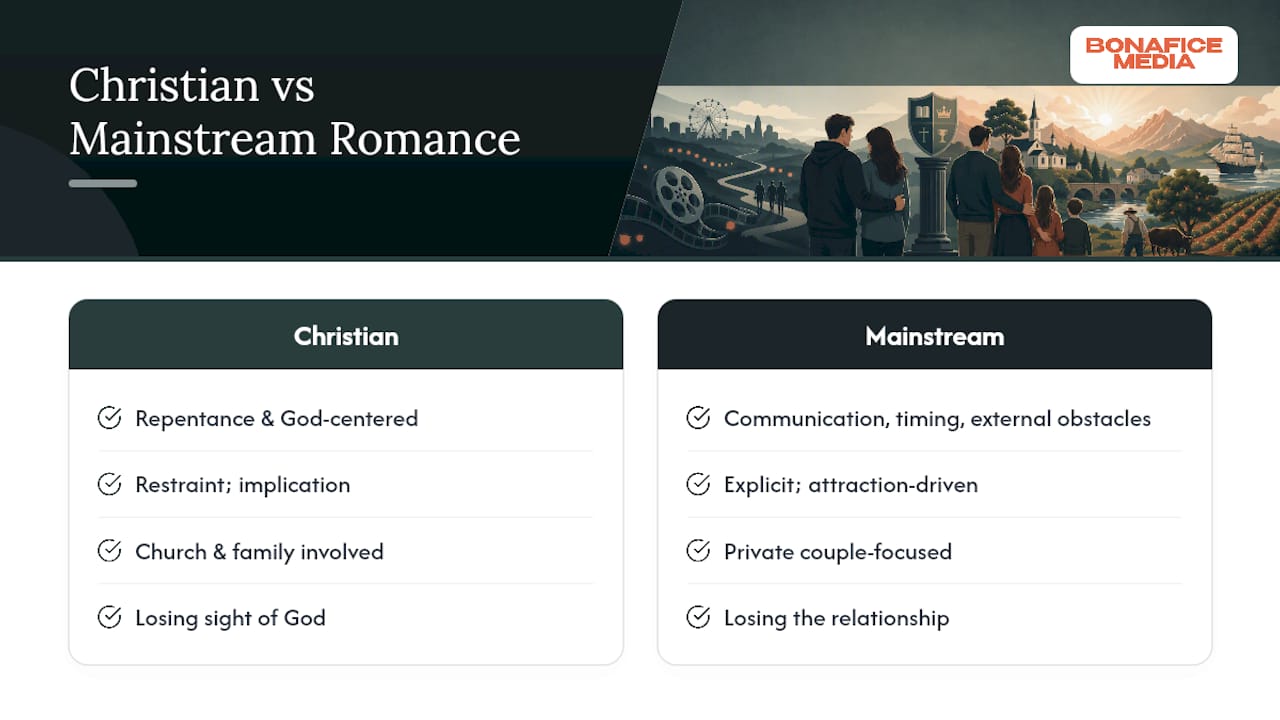
Physical intimacy is handled with restraint almost universally in this genre, often through implication rather than depiction, reflecting a biblical view of marriage and purity rather than a simple content rating decision. Mainstream romance treats physical attraction as a valid plot engine on its own; Christian romance generally treats it as something to be stewarded within marriage, which changes pacing and tension throughout the story.
Community also plays a structurally different role. Mainstream romantic leads often resolve conflict privately, just the two of them. Christian romance regularly brings pastors, parents, and church friends into the resolution, reflecting a theology where marriage is a covenant witnessed by a community rather than a private contract between two individuals. The stakes differ too: a mainstream romance risks losing the relationship, while a Christian romance often frames the deeper risk as losing sight of God amid the pursuit of another person, which is precisely the tension the strongest films in this genre choose to sit inside rather than resolve too quickly.
Why Gospel-Centered Love Stories Matter More Than Clean Content
Union with Christ, not romantic fulfillment, is the deepest longing Scripture describes for every believer, and the strongest films on this list understand that distinction even while telling a love story. The apostle Paul’s language of the church as Christ’s bride in Ephesians reframes marriage itself as a picture pointing beyond itself. Reading that passage directly makes clear why repentance and sanctification matter more in these stories than a tidy content rating.
The films worth your family’s time model this by showing characters change through grace, not just fall in love. That’s worth pausing a movie to discuss with your children: not just “was that clean?” but “did that love point them toward Christ?”
— The Bonafice Media Team
Watch Vetted Christian Romance Movies on Bonafice Media
Every title in this list can be found and previewed inside Bonafice Media’s library, which passes 1,300 pieces of curated content across films, children’s programming, and educational resources, all screened for a scripture-centered worldview before it’s added.

A subscription runs $4.99/month or $44.99/year, with apps available on iOS and Android and a dedicated TV app currently in development; until then, mirroring or Chromecast from Chrome gets any title onto your television screen. Inside the app, search by tag for “romance” or browse curated collections built around themes like courtship, redemption, and marriage, and each listing includes a short content note so you’re not guessing about advisories before you press play. If your family has been piecing together recommendations from scattered review sites, browse the full library on Bonafice and start a subscription to get vetted picks in one place instead.
For readers who want a broader view of new releases before deciding what to add to a watchlist, Flicksy’s roundup of 2026 movie releases offers useful production and box-office context worth checking alongside any content advisory.
Where to Verify Content Advisories Before You Watch
Movieguide and Dove.org publish detailed content breakdowns, age recommendations, and worldview notes worth checking against Bonafice’s own curation before a family movie night. Cross-referencing both takes only a few minutes and closes most remaining gaps.
Sources
This article was created with AI assistance under human direction and review. Bonafice Media uses AI as a tool to be faithfully stewarded, never as a substitute for human judgment, study, creativity, or responsibility. Content is reviewed for accuracy, biblical faithfulness, and clarity before publication. Scripture references use the Legacy Standard Bible as applicable. It’s for general educational and informational purposes only and is not professional, legal, financial, or pastoral advice.