

Trustworthy Christian movie reviews come from a handful of dependable sources: content-concern grids like Dove.org, theological reviewers like Movieguide, and structured critics like Plugged In. Each focuses on three things: content concerns (language, violence, sexuality, substance use), the film's underlying worldview, and age suitability. Used together, they let a family screen a title in minutes and walk away with real discussion material, not just a pass/fail verdict.
TL;DR:
- Christian review sites vary, with Dove.org providing quick content checks and Movieguide offering insights into worldview and moral implications.
- Reading reviews should prioritize the spiritual elements and worldview discussion before focusing on content concerns to better understand a film's theological message.
- Discipleship from movie viewing involves setting family expectations, asking age-appropriate questions, and linking film themes to Scripture for meaningful family conversations.
- Recent faith-based films like Family Camp and Beyond Belief demonstrate the diversity of themes, with some incorporating gospel elements and others emphasizing moral resonance.
- Curated platforms like Bonafice Media offer families a library of biblically aligned content with built-in discussion guides, reducing the need for separate review research.
Table of Contents
- Where to find reliable Christian movie reviews
- How do you read a Christian movie review well?
- Turning movie reviews into family discipleship
- Notable recent faith-friendly films worth reviewing
- Bonafice Media: how our curation helps families
- The historical roots of Christian filmmaking
- Common themes and genres in Christian cinema
- Why do movie reviews shape what Christian families watch?
- How Christian films stack up against mainstream releases
- Why faithful reviews matter to how we watch
- Try Bonafice: curated Christian streaming built for Reformed families
- Sources
Where to find reliable Christian movie reviews
Not every review site does the same job, and knowing the difference saves time on a Friday night when the kids are already asking what's for movie night. Some sites exist to give you a fast content scan. Others exist to help you think theologically about what you just watched.
- Dove.org runs one of the largest family-friendly review databases around, with age-appropriate guidance across thousands of titles. It's built for speed. If you need a quick "is this okay for an eight-year-old" answer, start here.
- Movieguide goes further than a content checklist. Its review of THE LEGO MOVIE calls out a strong moral worldview and Christian allegory in an unlikely place, noting just one moderately questionable element. This is the site for parents who want a worldview read, not just a tally of curse words.
- Plugged In structures every review with sections like "Positive Elements," "Spiritual Elements," and specific content breakdowns, as shown in its review of Beyond Belief. It sits between a content grid and a theological essay.
- Christian Parenting leans toward the discipleship angle, evaluating whether a film like Family Camp can spark honest family conversation, not just whether it's clean.
- Independent faith-based blogs and church media outlets round out the picture, often covering newer or smaller releases the bigger sites miss.
If you want a five-minute filter, use Dove or Plugged In's content grid. If you want material for a conversation after the credits roll, Movieguide or Christian Parenting will serve you better.
How do you read a Christian movie review well?
A review is only as useful as the order you read it in. Skimming straight to the star rating skips the parts that actually matter for a Christian household.
- Scan the content-concerns grid first. Look at language, sexual or romantic content, violence, and drug or alcohol use. This tells you fast whether a film is even in the running for family night.
- Read the spiritual elements or worldview section next. This is where a reviewer explains how the film treats sin, redemption, and grace, not just whether a character says a swear word. A film can be squeaky clean and theologically empty, or gritty and gospel-shaped. Read for which one you're dealing with.
- Weigh artistic quality against age. A message poorly delivered, through clumsy dialogue or a preachy tone, gives you less to discuss than a well-made film with subtler themes. Ask whether the story is good enough to hold a conversation, not just a moral.
- Check for a discussion guide. Some reviews, and many parenting blogs, pair a film with ready-made questions, which saves you the work of writing your own.
Reviewers use phrases like "strong moral worldview" or "moderately questionable" as shorthand. "Strong moral worldview" usually signals a film reinforces biblical categories of right and wrong, even without explicit gospel content. "Moderately questionable" flags something worth a heads-up conversation, not necessarily a dealbreaker.
Pro Tip: Read the spiritual elements section before you read the content-concerns grid. Starting there keeps you evaluating the film's message first, instead of getting anchored on a single line of dialogue.
Turning movie reviews into family discipleship
A review tells you what's in a film. What you do with that information is where the real work happens. Before pressing play, decide whether any scenes need pre-screening, and set expectations out loud so nobody is caught off guard.
Discussion questions should shift with age:
- Young children: "Was that a wise choice or a foolish one? Why?"
- Tweens: "What happened because of that decision? Would you have made the same one?"
- Teens: "What does this film assume about God, truth, or human nature? Where does it disagree with Scripture?"
- Adults: "What theological claim is this story making, even indirectly? How would you counsel someone who believed it?"
A comedy like Family Camp is a good test case. Christian Parenting notes the film balances humor with an honest look at the messiness of family life, which opens the door to real talk rather than a lecture.
Close the evening with something concrete: a related Scripture passage from the LSB, a short prayer tied to the film's theme, or a memory verse the family commits to that week. Discipleship happens in the follow-through, not just the viewing.
Notable recent faith-friendly films worth reviewing
A handful of recent titles keep coming up across Christian review sites, and each earns a different verdict.
- Beyond Belief — Plugged In's structured breakdown flags spiritual themes worth discussing alongside some content concerns; best for teens and up after a parent reads the full review.
- Family Camp — a comedy that uses real family friction for laughs and honest reflection; solid for the whole family, including younger kids.
- David (animated) — reviewed for its faith themes and production quality, a strong pick for families wanting biblical narrative done with real craft.
- THE LEGO MOVIE — not marketed as faith-based, yet Movieguide finds a strong moral worldview and Christian allegory beneath the humor, suitable for most ages.
That last one matters: worldview resonance shows up in unexpected places, which is exactly why the review, not the marketing, should guide the decision. Read the full write-up on the source site before committing an evening to any of these.
Bonafice Media: how our curation helps families
Bonafice Media applies the same evaluation logic behind every title we add: content concerns checked, worldview weighed against Scripture, and discussion material built in rather than left for parents to invent on their own.
The library now holds thousands of pieces of content spanning films, children's programming, teaching resources, and homeschool material, all curated for confessionally Reformed households.
- Every title is screened for biblical alignment before it's added, not just general "family-friendly" branding.
- Discussion guides accompany much of the film and children's programming.
- Homeschool families get supplemental educational content alongside entertainment in one place.
If you want curated Christian streaming instead of piecing together reviews film by film, that's the gap this platform exists to close.
The historical roots of Christian filmmaking
Christian cinema didn't start with modern faith-based studios. It traces back to Bible epics of the mid-20th century, films built on the assumption that Scripture itself was compelling drama. Those productions had budgets and audiences mainstream studios respected.
That era faded as Hollywood secularized through the late twentieth century, and explicitly Christian films became a niche market, often low-budget and preachy. The 2000s and 2010s saw a resurgence, first through independent faith-based studios producing message-heavy dramas, then through better-funded projects aiming for real craft alongside conviction.
The trajectory matters for how you read a review today. Older faith-based films get graded generously by nostalgia; newer ones are held to a higher production bar because audiences, including Christian ones, have seen what quality looks like. A reviewer who understands that history will note when a film clears that bar and when it's coasting on subject matter alone. Understanding where Christian cinema has been helps you calibrate expectations for where a given title sits.
Common themes and genres in Christian cinema
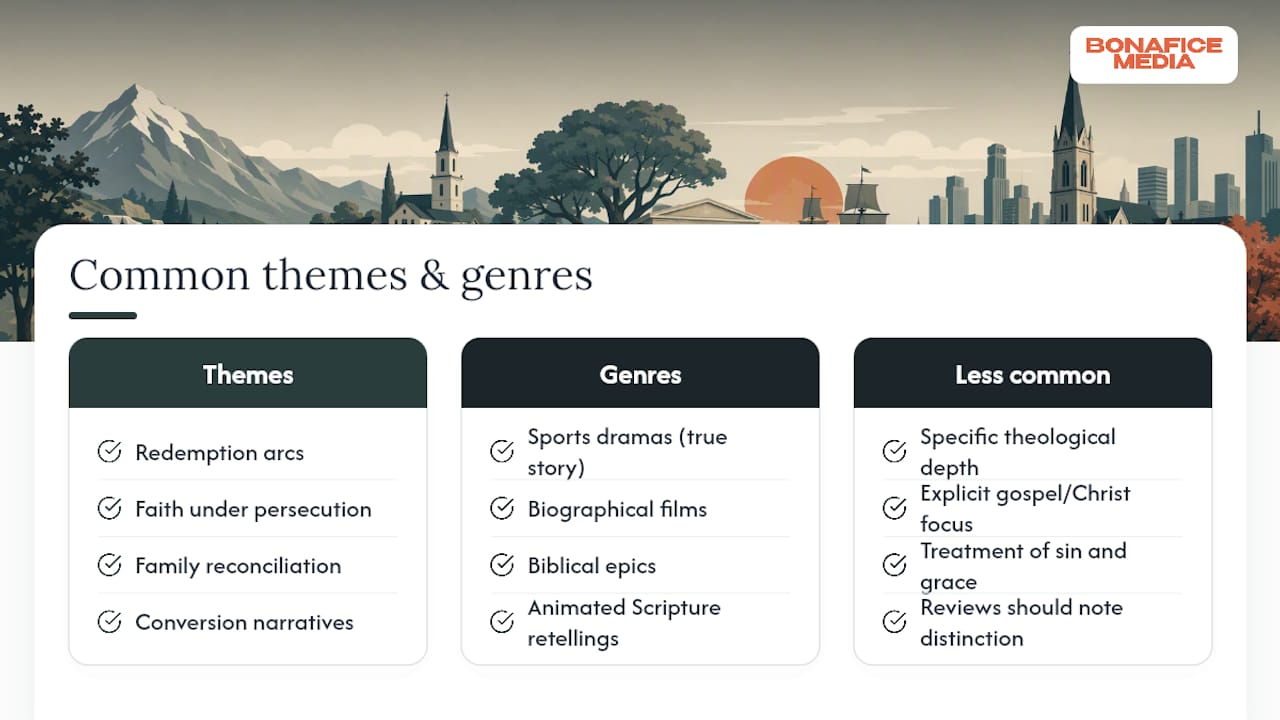
Christian films cluster around a narrow set of recurring themes: redemption arcs, faith under persecution, family reconciliation, and conversion narratives. Sports dramas and biographical films have become particularly common vehicles, since a true story about overcoming adversity gives filmmakers a built-in redemption structure without forcing dialogue into a sermon.
Biblical epics and animated retellings of Scripture, like David, form another steady genre, aimed at introducing younger viewers to biblical narrative through familiar storytelling formats. Comedy has grown too, as titles like Family Camp prove that humor and honest portrayals of family dysfunction aren't mutually exclusive with a wholesome message.
What's less common, and worth noting, is genuine theological depth. Many faith-based films settle for a general "have faith" message rather than engaging specific doctrine, sin, or the nature of grace. Watch for reviewers who distinguish moral messaging from actual gospel content. A film can encourage kindness without ever pointing to Christ, and a good review will tell you which one you're getting.
Why do movie reviews shape what Christian families watch?
Reviews function as a filter before a dollar or an hour ever gets spent. A family checking Dove or Plugged In before choosing a streaming title is making a decision the industry feels directly, since faith-based box office and streaming numbers respond to word-of-mouth from trusted reviewers more than to traditional advertising.
That influence runs both directions. Strong reviews for a well-made faith-based film, one that respects both craft and theology, signal to studios that quality pays off, which pushes future productions to raise their bar rather than lean on subject matter alone. Weak reviews for a preachy, poorly made film discourage repeat attempts at that same formula.
Reviewers also shape expectations before a viewer even watches. If Movieguide flags a strong moral worldview in an unexpected mainstream release, families who'd otherwise skip it give it a chance. If Plugged In's content grid flags a concern parents weren't expecting, that same family walks in prepared instead of blindsided. Either way, the review has already done real work before the opening scene plays.
How Christian films stack up against mainstream releases
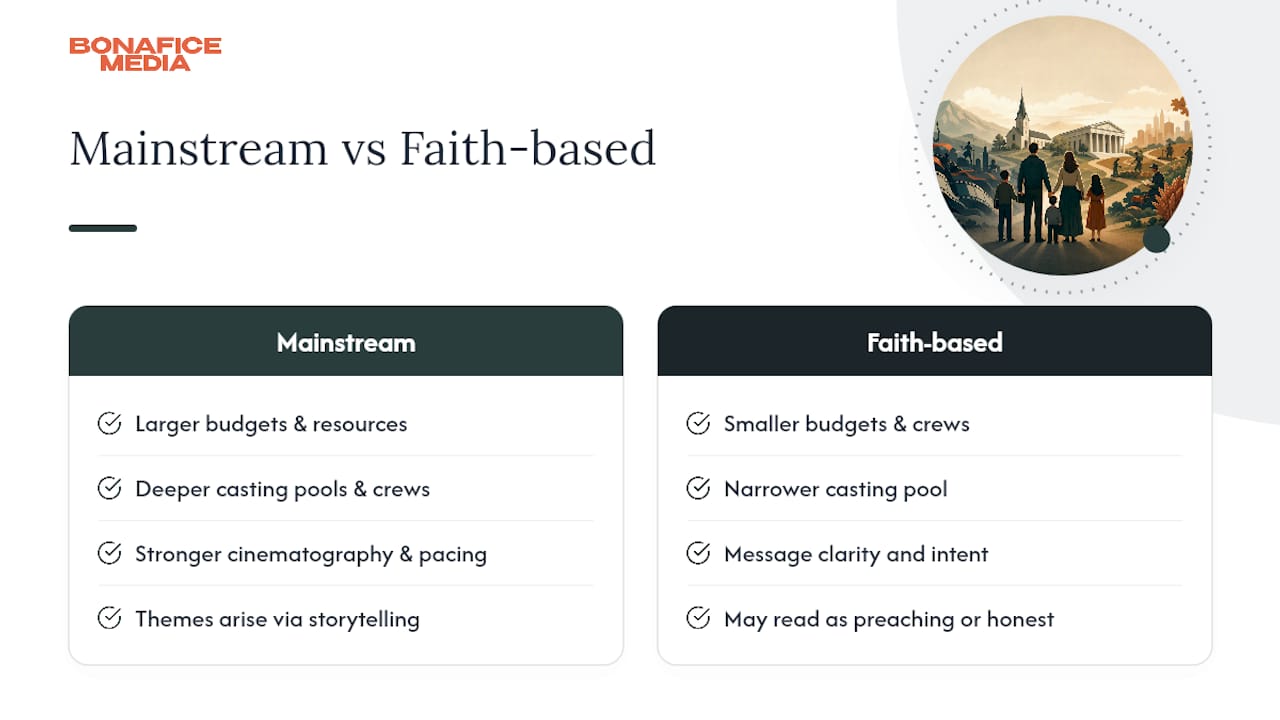
Production quality in faith-based film has closed real ground over the past decade, but the gap hasn't disappeared. Mainstream studios still command larger budgets, deeper casting pools, and more experienced crews, which shows up in cinematography and pacing even when the story itself is weaker.
Where Christian films often win is message clarity paired with intent. A mainstream film with moral resonance, like the allegory Movieguide finds in THE LEGO MOVIE, stumbles into its themes as a byproduct of good storytelling. A faith-based film usually builds toward its message deliberately, which can land as either refreshing honesty or heavy-handed preaching depending on the writing.
The smartest approach skips the either/or. Mainstream films sometimes carry more moral weight than their marketing suggests, and faith-based films sometimes deliver more craft than their reputation implies. A good review tells you which category you're actually looking at, rather than assuming the label on the poster settled the question. For deeper cultural analysis of how popular film handles theological themes, commentary from a Christian perspective can add useful context beyond a single review.
Why faithful reviews matter to how we watch
Scripture calls us to take every thought captive, and that includes the two hours we spend in front of a screen. A review grounded in sound doctrine does more than flag a swear word. It asks whether a story tells the truth about sin, grace, and redemption. Bonafice Media curates with that conviction: Reformed theology first, content concerns second. If you have questions about how a title was evaluated, we welcome them.
— The Bonafice Media Team
Try Bonafice: curated Christian streaming built for Reformed families
Bonafice Media gives you what a review alone can't: a library already screened, so you're not starting the evaluation checklist from zero every Friday night. The platform holds over 1,300 pieces of content, films, children's programming, teaching resources, and homeschool material, all curated for biblical alignment rather than a generic "clean content" label.
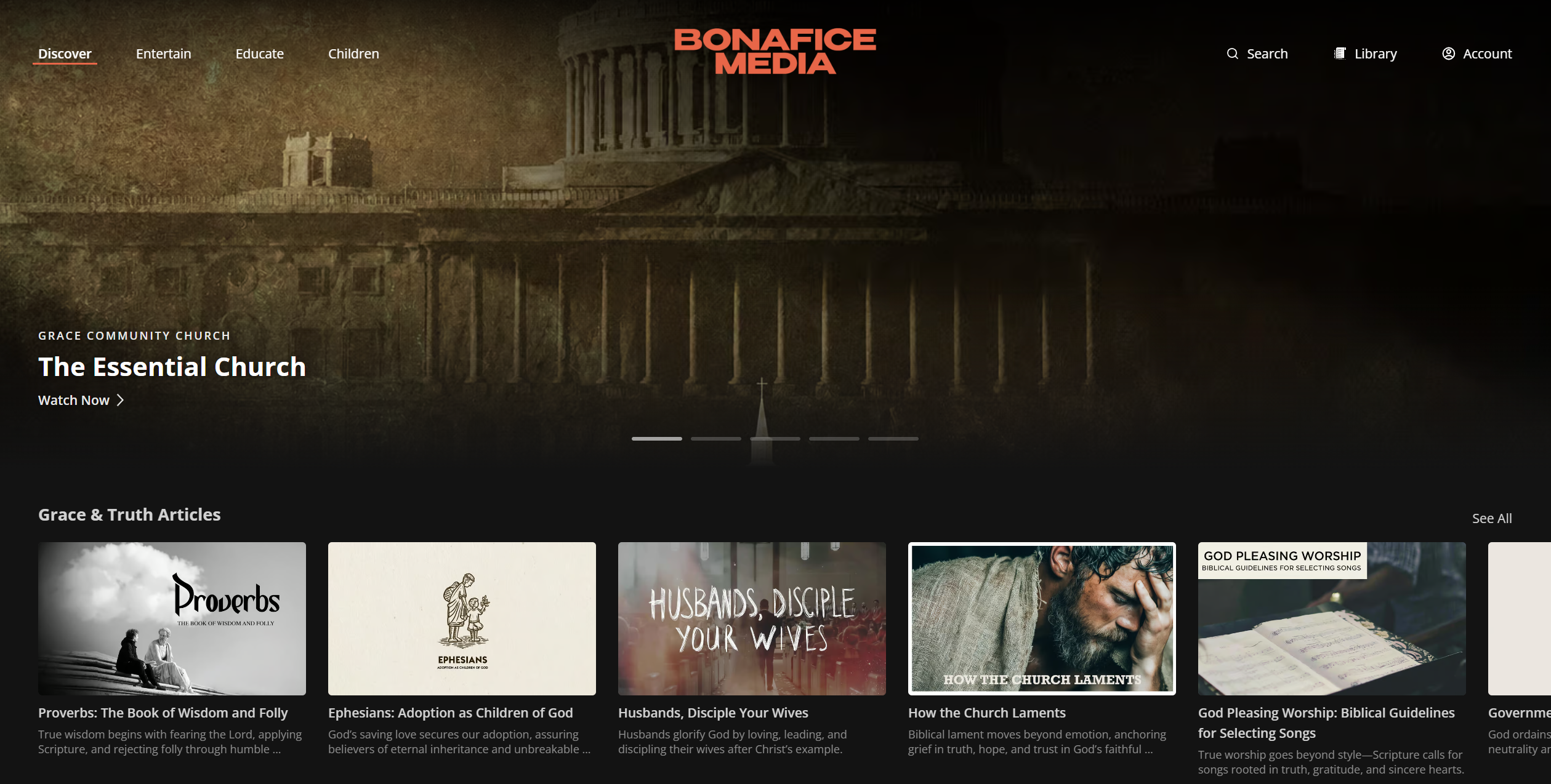
Subscriptions run $4.99 a month or $44.99 a year, with iOS and Android apps available now. There's no dedicated TV app yet or one is planned as budget allows, but you can stream to your television today by mirroring from your phone or casting through Google Chrome. Discussion material comes built into much of the library, so the conversation you'd normally build from a review is often already there waiting. If you'd rather spend movie night watching than researching, explore Bonafice's library and start your subscription today.
Sources
- THE LEGO MOVIE review — Movieguide
- Dove
- Beyond Belief — Plugged In review
- Family Camp: a Christian comedy for the whole family — Christian Parenting
- David animated movie review — Kerman Covenant
This article was created with AI assistance under human direction and review. Bonafice Media uses AI as a tool to be faithfully stewarded, never as a substitute for human judgment, study, creativity, or responsibility. Content is reviewed for accuracy, biblical faithfulness, and clarity before publication. Scripture references use the Legacy Standard Bible as applicable. It's for general educational and informational purposes only and is not professional, legal, financial, or pastoral advice.