
Watch curated, gospel-centered documentaries rather than gambling on mainstream platform algorithms. Start with The Case for Christ and Bonhoeffer if you want a first pick for adults or teens, then check Bonafice Media's library for a vetted, family-safe streaming option that screens content for biblical fidelity before it ever reaches your living room.
TL;DR:
- Curated Christian documentaries adhere to biblical fidelity, avoiding fringe content like Jesus Camp and emphasizing apologetics, biography, and mission stories.
- Availability varies across platforms; specialty Christian streaming services like Bonafice Media provide vetted, consistent access to trustworthy titles.
- Films such as The Case for Christ, Bonhoeffer, and Tortured for Christ serve different audiences but focus on evidence-based apologetics, church history, or persecution.
- Use specific criteria—such as theological consistency and source transparency—when selecting family-friendly documentaries, and consider previewing intense content first.
- Watching well-chosen documentaries can reinforce doctrine, foster meaningful family and church conversations, and serve as practical discipleship tools.
Table of Contents
- What Are Christian Documentaries, and Why Curation Matters
- The Best Christian Documentaries to Watch This Year
- Where to Watch Christian Documentaries Streaming Online
- How to Choose Family-Friendly, Theologically Sound Documentaries
- Why Bonafice Media Is a Trustworthy Source for Vetted Picks
- The Lasting Influence of Christian Documentary Filmmaking
- Common Types of Christian Documentaries Explained
- Who Makes These Films: Filmmakers Worth Knowing
- How These Films Shape Everyday Faith Practice
- A Reflection on Documentaries as Family Discipleship Tools
- Find Your Next Family Movie Night With Bonafice Media
- Sources
What Are Christian Documentaries, and Why Curation Matters
Christian documentaries are nonfiction films that examine biblical history, church figures, apologetics, missions, or worship practice through a lens shaped by Christian conviction rather than secular neutrality. That distinction sounds small until you actually sit down to watch one. A documentary about the early church made by a network with no theological commitments will frame the resurrection as "a claim early Christians made." A documentary made from a confessional Christian perspective will treat it as historical fact worth defending with evidence. Both call themselves documentaries. Only one respects what Scripture actually teaches.
This matters because streaming catalogs mix both types indiscriminately. You can search "Christian documentaries" on a major platform and land on films ranging from careful apologetics work to fringe subculture pieces that misrepresent ordinary Christian practice. Jesus Camp, for instance, gets recommended constantly in these searches, but reviewers note it depicts a narrow charismatic subculture that most Christian households would not recognize as representative of their own faith or church life, a caution worth keeping in mind before pressing play with your kids in the room, as one detailed review points out.
That is the gap this guide closes. Below is a curated list of the strongest Christian faith films available, organized by what they cover and who they suit, followed by practical guidance on where to actually find them and how to evaluate any documentary that is not on this list.
The Best Christian Documentaries to Watch This Year
Here are the titles worth your time, drawn from what faith-focused reviewers and Reformed-friendly sources consistently recommend. Some are built for family movie night. Others are better suited to adult study or a youth group discussion.
-
The Case for Christ — Based on Lee Strobel's investigative journey from atheism to faith, this documentary follows a journalist cross-examining the historical evidence for the resurrection. It works as an evangelism tool for skeptical friends or teens wrestling with doubt, and Movieguide lists it among the most faith-affirming entries in the genre. Appropriate for teens and adults; younger kids may lose the thread of the legal-style argumentation.
-
The Case for Miracles — Strobel returns with a similar cross-examination format, this time investigating claims of the miraculous through interviews with doctors, scientists, and eyewitnesses. The interview-and-cross-examination structure is the film's own stated approach, and it tends to land well with viewers who respond better to evidence than emotion. Best for adults and older teens who want a rigorous, rather than sentimental, case for supernatural intervention.
-
Bonhoeffer — A biographical treatment of Dietrich Bonhoeffer, the German pastor and theologian executed for resisting the Nazi regime. Gospel Relevance recommends it for its historical depth and theological seriousness, and it pairs naturally with a study of costly discipleship. Strong for high schoolers and adults; the subject matter (Nazi Germany, execution) makes it too heavy for young children.
-
Tortured for Christ — Documents the underground church in Communist Romania and the persecution testimony of Pastor Richard Wurmbrand. It is a sober, unflinching look at what faithfulness costs under totalitarian regimes, and it makes an excellent complement to a study of the persecuted church. Best for teens and adults; the content on torture is graphic enough that younger children should skip it.
-
Beyond the Gates of Splendor — Tells the story of five missionaries killed by the Waodani people in Ecuador in 1956, then follows the remarkable reconciliation that followed as the missionaries' families returned to live among the same tribe. It is one of the most powerful missionary stories on film and works well for family viewing with older children present. A strong pick for a missions-focused family night or homeschool unit on world evangelism.
-
Show Me the Father — An exploration of fatherhood through the lens of the gospel, using personal testimonies to examine how earthly fathers shape our understanding of God the Father. Movieguide highlights it as a faith-affirming pick for families processing father wounds or preparing for Father's Day services. Appropriate for the whole family, though its emotional weight lands hardest with adults.
-
The Jesus Music — Traces the history of contemporary Christian music from its Jesus Movement roots in the 1970s through today's worship industry. It is a fascinating look at how the church's music culture formed, and it works well for teens interested in music or church history. Family-friendly, with enough nostalgia value to hold adult attention too.
-
Epic — A historical survey documentary examining the reliability and transmission of Scripture across centuries. Gospel Relevance recommends it specifically for study use, and it fits naturally into an apologetics unit or a homeschool Bible history course. Best suited to teens and adults who want the textual case for Scripture's reliability laid out in detail.
-
After Death — Investigates near-death experiences and what they might reveal about the afterlife, interviewing both skeptics and believers. Movieguide flags it as useful for evangelism conversations, though families should preview it first since near-death content can be intense for younger viewers.
-
The Case for Heaven — A companion piece in the Strobel investigative series, this one examines what happens after death from a biblical and evidentiary standpoint. It suits adults and teens processing grief or questions about eternity, and it pairs naturally with a study of resurrection hope.
-
Puritan — A historical documentary on the Puritan movement, its theology, and its lasting influence on Reformed Christianity. Recommended by Gospel Relevance as study material, it fits a homeschool church history unit better than a casual family night.
-
Calvinist — Traces the history and theology of Calvinism from the Reformation forward. Like Puritan, it is a study-oriented pick rather than light viewing, best reserved for teens and adults working through Reformed doctrine in a structured way.
-
Spirit and Truth — Examines worship theology and practice across church history, useful for congregations or families thinking through what biblical worship actually looks like. A solid pick for a church small-group discussion night.
-
Beyond Utopia — Documents the harrowing escape of North Korean defectors, several of whom are guided by an underground Christian pastor network. It is intense, unflinching, and one of the most gripping missions-adjacent stories available, best reserved for teens and adults given its depiction of danger and hardship.
Most of these films fall naturally into a handful of categories: apologetics and evidence (The Case for Christ, The Case for Miracles, The Case for Heaven, Epic), biography and history (Bonhoeffer, Puritan, Calvinist, The Jesus Music), and missionary and persecution testimony (Beyond the Gates of Splendor, Tortured for Christ, Beyond Utopia). Knowing which bucket a film sits in helps you match it to the occasion, whether that is a Sunday evening family night or a homeschool unit that needs primary source material.
Where to Watch Christian Documentaries Streaming Online
Availability shifts constantly, and that is the single most frustrating part of building a Christian documentaries streaming habit. A title available on one platform this month can disappear or move behind a rental fee the next. A few practical habits solve most of the frustration:
- Check general-market platforms first for titles like The Case for Christ or The Jesus Music, since these often carry wider distribution deals.
- Search specialty Christian streaming apps for harder-to-find historical and theological titles like Puritan, Calvinist, or Epic.
- Look for free, legal uploads on established ministry YouTube channels for older documentaries whose distribution rights have lapsed.
- Scan a curated library like Bonafice's before assuming a title is unavailable; catalogs change monthly, and a title absent last quarter may already be live.
- Expect regional restrictions. Licensing varies by country, so a film streaming freely in one market may require a rental or purchase elsewhere.
Mainstream platforms host plenty of films that interest Christian viewers, but they rarely apply a consistent biblical worldview to how those films get categorized or recommended. A platform's algorithm treats Jesus Camp and The Case for Christ as interchangeable "Christian documentary" results, when one is a critical look at a narrow charismatic subculture and the other is a straightforward apologetics case. That inconsistency is exactly why curation, rather than raw search, is the better strategy for a family trying to avoid an awkward surprise mid-movie-night.
How to Choose Family-Friendly, Theologically Sound Documentaries
Not every film wearing the "Christian documentary" label deserves a spot in your queue. Use these five criteria before you commit an evening to one:
- Theological alignment. Does the film treat Scripture as authoritative, or does it treat biblical claims as merely one perspective among many? A documentary that hedges on the resurrection or the reliability of Scripture is not neutral. It is quietly undermining the thing it claims to document.
- Source transparency. Good documentaries name their historians, theologians, and primary sources. If a film makes sweeping historical claims without citing who is making them, treat it with suspicion.
- Expert testimony quality. Interviews with actual scholars, pastors, or eyewitnesses carry more weight than a narrator's unsupported assertions. Apologetics-driven films that lean on expert cross-examination tend to persuade skeptical viewers more reliably than emotionally driven films alone.
- Balance over sensationalism. A documentary that leans hard on dramatic music and quick cuts to manufacture urgency is usually compensating for a thin argument.
- Age-appropriateness. Persecution, martyrdom, and near-death testimony are valuable subjects, but they are not automatically appropriate for a seven-year-old just because the film is "Christian."
Three red flags to watch for: a narrator who frames biblical events as "what some believed" rather than what happened; a total absence of named theological consultants; and heavy reliance on emotional music cues instead of substantive interviews. Documentaries filmed with a secular lens tend to present faith as a cultural artifact worth studying. Documentaries filmed with a confessional lens present it as true. That framing difference changes how a viewer, especially a child, absorbs what they are watching.
Pro Tip: Before screening a documentary with kids, read a short Scripture passage tied to the film's theme and pose one discussion question. A brief debrief afterward corrects any framing bias and turns a passive watch into an active family conversation, a habit Breakpoint's commentary team regularly recommends for exactly this reason.
Why Bonafice Media Is a Trustworthy Source for Vetted Picks
Specialty Christian streaming libraries exist precisely to solve the vetting problem this guide just walked through. Rather than previewing every film a search engine surfaces, families can lean on a platform that has already applied theological and age-appropriateness screening before a title ever appears in the catalog.
Bonafice Media curates its library of more than 1,300 pieces of content specifically for households that want biblical convictions respected, not merely tolerated. That library spans films, children's programming, music, books, and podcasts, and it is built with homeschool families in mind, offering wholesome educational content alongside entertainment. A subscription runs at a low monthly or annual fee, with iOS and Android apps already available and a TV app planned.
- Curation filters for biblical fidelity before content ever reaches the catalog.
- Homeschool families get study-friendly material without hunting across five different platforms.
- A single subscription replaces the guesswork of vetting each title individually.
Before you commit an evening to any documentary, it is worth a quick scan of the Bonafice app library to see what is currently available.
The Lasting Influence of Christian Documentary Filmmaking
The genre's reach has grown well past niche church basements. The Case for Christ introduced apologetics arguments to audiences who would never open a systematic theology text, and its cross-examination format, built around Lee Strobel's own journalistic instincts, gave skeptics a familiar structure for engaging supernatural claims. Missionary documentaries carry a different kind of weight. Beyond the Gates of Splendor did something rare: it took a story many churchgoers already knew from missionary biography and gave it visual and emotional force that print never could, particularly in the reconciliation scenes decades after the original killings.
Historical and biographical entries like Bonhoeffer and Puritan serve a quieter but equally important function. They give Christians language and imagery for church history that Sunday sermons rarely have time to cover in depth. A documentary can compress decades of Reformation theology or wartime resistance into ninety minutes of testimony and archival footage, making dense history accessible to a teenager who would never pick up a Bonhoeffer biography unprompted.
Reception has been mixed only when documentaries drift from confessional framing into cultural observation, as critics noted with Jesus Camp, which drew attention for depicting an unusual subculture rather than representative Christian practice. That reception gap is instructive. Audiences respond best, and trust the material most, when a documentary is honest about the conviction behind its lens rather than pretending to a neutrality it does not actually hold.
Common Types of Christian Documentaries Explained
Understanding the genre's subcategories helps you match a film to the right occasion instead of grabbing whatever surfaces first in a search.
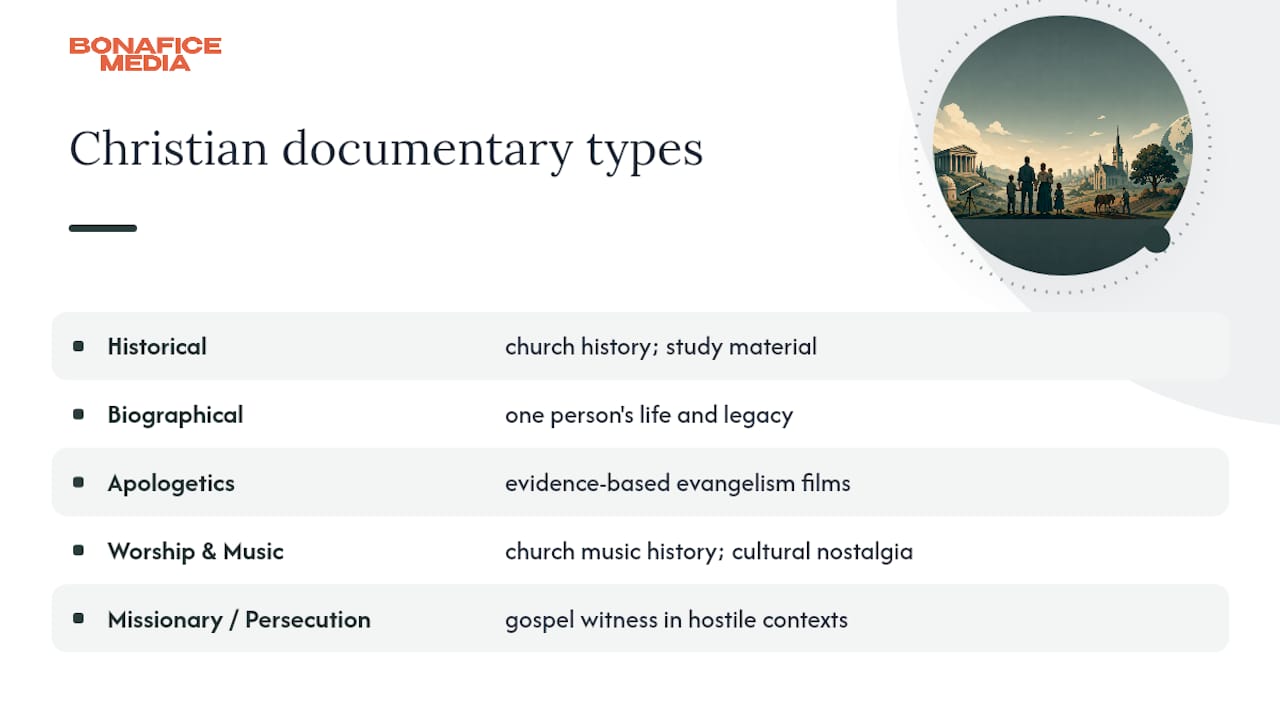
Historical documentaries dig into church history, doctrinal movements, or specific eras, films like Puritan and Calvinist fall here. They reward patient viewing and work best as study material rather than casual entertainment.
Biographical documentaries follow a single figure's life and legacy. Bonhoeffer is the clearest example in this list, using one man's resistance to totalitarianism as a lens for costly discipleship.
Apologetics documentaries build a case for the truth of Christian claims using interviews, expert testimony, and investigative structure. The Case for Christ, The Case for Miracles, and The Case for Heaven all follow this format, and Movieguide's reviewers consistently flag this style as effective for evangelism.
Worship and music documentaries trace how the church's musical culture formed and evolved. The Jesus Music and Spirit and Truth both fit here, offering a cultural history lesson wrapped in nostalgia.
Missionary and persecution documentaries document the cost of gospel witness across hostile environments. Beyond the Gates of Splendor, Tortured for Christ, and Beyond Utopia all belong to this category, and they consistently produce the strongest emotional response from viewers precisely because the stakes are real and the outcomes were not guaranteed.
Wikipedia's own category listing for documentary films about Christianity reflects how broad this genre has become, spanning dozens of titles across every one of these subcategories.
Who Makes These Films: Filmmakers Worth Knowing
Faith-based documentary production has professionalized considerably. Where early Christian films often carried a homemade, low-budget feel, today's strongest entries come from teams that understand both theological substance and cinematic craft. The Strobel-based films (The Case for Christ, The Case for Miracles, The Case for Heaven) share a consistent investigative structure built around courtroom-style cross-examination, a format that Strobel's own production approach has leaned into deliberately because it persuades skeptical audiences more reliably than films built purely on testimony.
Missionary story documentaries like Beyond the Gates of Splendor required a different production model entirely, one built on years of relationship with the Waodani community and the missionary families themselves, since the story only works if the reconciliation shown on screen is genuinely earned rather than staged for the camera.
Historical and theological documentaries such as Bonhoeffer, Puritan, and Calvinist rely heavily on archival research, academic consultants, and primary-source access, since a shaky historical claim in this subgenre gets caught immediately by informed viewers. The best producers in this space treat theological accuracy as a production requirement, not an afterthought bolted on for marketing.
What separates a lasting Christian documentary from a forgettable one usually comes down to whether the production team treated Scripture and church history as things to get right, not just backdrop for a compelling human story.
How These Films Shape Everyday Faith Practice
Christian documentaries have become a quiet but genuine discipleship tool inside households and churches that might never assign a theology textbook. A film like Tortured for Christ does something a sermon on persecution rarely accomplishes: it puts a face, a voice, and archival footage behind an abstract concept, and that concreteness sticks with viewers, especially teenagers, far longer than a lecture would.
Youth groups increasingly build discussion nights around a documentary clip rather than a straight Bible study, using Show Me the Father or The Case for Christ as a launching point for conversations about doubt or family wounds that a cold open discussion question rarely reaches on its own. Homeschool co-ops lean on titles like Epic and Puritan to supplement church history units, giving students visual and narrative material that a textbook chapter cannot replicate.

The apologetics subgenre in particular has shifted how ordinary believers engage with skeptical friends. Instead of trying to construct their own defense of the resurrection from scratch, a Christian can hand a skeptical coworker The Case for Christ and let Strobel's own investigative journey do the persuasive work. That shift, from personal argument to shared film, has lowered the barrier for evangelism conversations that many believers previously avoided out of fear they lacked the answers.
A Reflection on Documentaries as Family Discipleship Tools
Documentaries teach doctrine in a way that sticks precisely because they show rather than assert. A film does not just tell you that persecution is real; it puts Richard Wurmbrand's testimony on screen and lets the weight of it land on its own. That combination of teaching and empathy is worth taking seriously as a discipleship tool, not just entertainment to fill a Friday evening.
Practically, this looks like a monthly family movie night built around one title from this list, followed by ten minutes of discussion using a single Scripture passage as an anchor. It looks like a youth leader clipping five minutes from Show Me the Father to open a session on the doctrine of adoption. It looks like a homeschool parent pairing Epic with a unit on the transmission of Scripture, letting the film do work a textbook alone cannot. None of this requires expertise. It requires a willingness to sit down together and let a well-made film start a conversation Scripture can finish.
— The Bonafice Media Team
Find Your Next Family Movie Night With Bonafice Media
Searching platform by platform for a documentary that will not embarrass you halfway through is exhausting, and mainstream catalogs mix confessional apologetics with fringe subculture films under the same search tag. Bonafice Media solves that by pre-screening its entire library for biblical fidelity before a single title reaches the catalog, so you are choosing from films already vetted rather than gambling on an algorithm.
The library runs over 1,300 pieces of content across films, children's programming, music, books, and podcasts, built specifically with homeschool families and church households in mind. A subscription costs $4.99 a month or $44.99 a year, with apps live on iOS and Android and a TV app in development; in the meantime, mirroring or Chromecast through Chrome gets Bonafice content onto your living room screen without trouble. Note that Bonafice curates entertainment and enrichment content, not a teaching curriculum, so parents still need their own lesson materials for structured schooling. For film discussion and reviewer perspective on faith-centered media, Faith & Freedom with Shemane Nugent offers another angle worth a listen.
Visit the Bonafice streaming library today and check what is available before your next family movie night.
Sources
- Jesus Camp review — Spirituality & Practice
- Top 10 Must-Watch Christian Documentaries - Movieguide
- 10 Christian Documentaries to Consider Watching - Gospel Relevance
- Home - The Case for Miracles Movie
This article was created with AI assistance under human direction and review. Bonafice Media uses AI as a tool to be faithfully stewarded, never as a substitute for human judgment, study, creativity, or responsibility. Content is reviewed for accuracy, biblical faithfulness, and clarity before publication. Scripture references use the Legacy Standard Bible as applicable. It's for general educational and informational purposes only and is not professional, legal, financial, or pastoral advice.