

Anger itself is not always sin. What makes it sin is what you do with it. Scripture is direct on this point: "Be angry, and yet do not sin" (Ephesians 4:26, LSB). The emotion can rise in you without your consent; what happens in the next sixty seconds is where obedience or rebellion begins.
Here is one tactic to use right now, before you read another word of theology: Pause. Pray. Step away.
- Pause the moment you feel your pulse rise or your voice sharpen.
- Pray a one-line prayer: "Lord, guard my tongue and my heart right now."
- Step away from the room or conversation until your body calms and your thinking clears.
That is a first-aid response, not a cure. Anger that keeps returning week after week is not a habit you break with willpower. It is a heart condition that needs Scripture, prayer, and often a wise counselor working on it together.
Key Takeaways
Biblical anger management works when Christians pair immediate Scripture-based tactics like pausing and praying with longer-term heart work through journaling, memorization, and counsel.
| Point | Details |
|---|---|
| Anger is not automatically sin | Ephesians 4:26 permits the emotion but forbids letting it turn into sin or linger past reasonable resolution. |
| "Righteous anger" is a weak defense | Scholarly analysis finds little New Testament support for treating righteous anger as a safe category for sinners. |
| Use the pause and soft answer | Proverbs 15:1's soft answer, paired with a short prayer, defuses most in-the-moment conflicts. |
| Find the root emotion | Pride, fear, and hurt usually hide beneath anger and need confession, not just behavior control. |
| Bonafice Media supports ongoing discipleship | Its teaching series and family videos reinforce anger-management lessons between counseling sessions. |
Table of Contents
- What Does the Bible Say About Anger and "Righteous Anger"?
- What Are Practical Ways to Control Anger in the Moment?
- When Should You Seek Christian Counseling for Anger?
- How Do You Build a 30-Day Plan for Christian Anger Management?
- How Does Anger Damage Relationships and Community?
- What Can Biblical Figures Teach You About Managing Anger?
- How Do You Cultivate Self-Control as the Fruit of the Spirit?
- A Note From the Bonafice Media Team
- A Christ-Centered Resource to Support Your Discipleship
- Sources
What Does the Bible Say About Anger and "Righteous Anger"?
The Bible's testimony on human anger is mostly a warning, not a permission slip. Ephesians 4:26–27 tells believers they may feel anger but must not let it become a foothold for sin, and must not carry it past sundown. James 1:19–20 goes further: "Everyone must be quick to hear, slow to speak and slow to anger; for the anger of man does not achieve the righteousness of God" (James 1:19–20, LSB). Matthew 5 raises the bar again, treating contempt and unresolved anger toward a brother as serious moral failures, not minor lapses.
A recurring question among Christians is whether they get to claim "righteous anger" the way Jesus displayed in the temple. A scholarly review of the New Testament's teaching on this question finds no clear support for treating righteous anger as a stable, repeatable category for sinful, imperfect people. Jesus could act in perfect righteous zeal because He had no sin mixed into His motives. You and I almost always do. That does not mean every flash of anger at real injustice is sinful. It means you should be deeply suspicious of your own certainty that your anger is the righteous kind, since pride and self-justification hide well inside indignation.
Memorize these three references. They will do more work for you in a heated moment than any long explanation:
- Ephesians 4:26–27, on the danger of nursed anger
- James 1:19–20, on being slow to anger
- Proverbs 15:1, on the power of a soft answer
What Are Practical Ways to Control Anger in the Moment?
Theology tells you why anger matters. Now you need what to actually do with your hands and your mouth in the next thirty seconds of a conflict.
Immediate tactics for the heat of the moment:
- Pause before you speak. Count to five, or longer if needed, before responding to the person who provoked you.
- Breathe deliberately. Slow, deep breaths lower the physical arousal that fuels reactive speech.
- Choose a soft answer. Proverbs 15:1 promises that "a harsh word stirs up anger," while gentleness turns wrath away.
- Pray a short, rehearsed line. Something like "Lord, help me honor You in this moment" takes ten to fifteen seconds and interrupts the escalation.
Habits to build over weeks, not just moments:
- Take your thoughts captive. Second Corinthians 10:5 calls believers to actively examine and correct their own thinking, not just their words.
- Keep an anger journal. Record the five W's for every flare-up: who, what, when, where, and why. Patterns emerge fast once you write them down.
- Map your triggers. Most anger has a short list of repeat offenders, whether that is a specific person, a certain tone of voice, or feeling disrespected in front of others.
- Name the secondary emotion. Counseling guidance from CCEF points out that anger almost always sits on top of something else, usually pride, fear, or hurt. Find that root and you find what actually needs repentance.
Pro Tip: Write your one-line trigger prayer today, before you need it. A phrase you have already rehearsed comes out under pressure far more reliably than one you try to invent in the middle of a fight.
When Should You Seek Christian Counseling for Anger?
Some anger clears up with a soft answer and a good night's sleep. Some does not, and pretending otherwise puts your marriage, your job, or your walk with Christ at risk.
Watch for these red flags:
- Rage that returns weekly regardless of circumstances
- Any physical aggression, threats, or violence
- Job loss or legal trouble tied to angry outbursts
- Thoughts of suicide or self-harm connected to your anger
- Relationships that keep breaking under the weight of repeated blowups
Any one of these is reason enough to call a pastor or a licensed Christian counselor this week, not "eventually." Faith-based counseling comes in several forms: pastoral counseling through your local church, licensed Christian counselors who blend Scripture with clinical training, and structured classes or discipleship groups built around anger and self-control.
On a first call, ask what confidentiality looks like, whether the counselor integrates Scripture directly into sessions, and how many sessions a typical case runs. Church leadership can often shorten the wait by connecting you directly to a trusted counselor rather than leaving you to search alone.
How Do You Build a 30-Day Plan for Christian Anger Management?
A month is long enough to build real traction and short enough to actually finish. Adjust the pace to your own church's counsel and your counselor's recommendations.
- Week 1: Install the pause. Practice the pause, pray, step away sequence on every irritation, even small ones. Log each attempt in a notebook.
- Week 2: Track your triggers. Keep the anger journal daily. By the end of the week, you should be able to name your top two or three recurring triggers.
- Week 3: Memorize and rehearse. Commit Ephesians 4:26–27 and James 1:19–20 to memory. Practice reciting them out loud in a calm moment, then again the next time you feel provoked.
- Week 4: Schedule counsel. Book a conversation with a pastor or Christian counselor, even if things feel better. A check-in while you are calm is more useful than a crisis call later.
- Ongoing: Review and adjust. Look back at your journal entries. Which tactics actually worked? Build those into a standing rule for how you respond going forward.
Small, measurable markers matter more than good intentions: a full week of journal entries, both verses recited from memory without notes, one scheduled consult on the calendar.
How Does Anger Damage Relationships and Community?
Unmanaged anger does not stay contained to the person who feels it. It spreads through households, friendships, and churches, leaving damage that outlasts the argument itself.
Proverbs repeatedly ties anger to broken relationships, warning that a quarrelsome spirit stirs up strife and that a person given to anger causes ongoing trouble for everyone nearby. Ephesians 4:31 goes a step further, listing bitterness, wrath, and slander together as things to be "put away," treating unresolved anger as a community problem, not a private one. A husband's short temper reshapes his home. A leader's harsh outbursts erode trust in a congregation. A friend's simmering resentment poisons a friendship long before either person names what happened.
There is also a physical cost that Scripture's wisdom anticipated long before modern medicine measured it. Clinical health guidance confirms that unmanaged anger raises blood pressure and stress hormones, compounding the relational damage with real physical harm to the angry person as well. The body keeps the score that the mouth refuses to settle.
This is why the church cannot treat personal anger as purely a private matter between an individual and God. James 1:19–20 was written to a community, not a solitary reader. A congregation that tolerates chronic anger in its members is choosing slow relational decay over the harder, better work of confrontation and repentance.
What Can Biblical Figures Teach You About Managing Anger?
Scripture does not hide its major figures' struggles with anger. It records them, and it records what came next.
Moses struck the rock in anger at Meribah instead of simply speaking to it as God commanded, and paid for that lapse by being barred from entering the Promised Land. His anger was often justified in its cause, provoked by real rebellion, but the sin was in the unauthorized action his anger produced.
Jonah sat outside Nineveh angry that God had shown mercy to a city Jonah wanted destroyed. His anger exposed a heart more attached to his own preferences than to God's compassion, and the book ends with God gently confronting that misplaced priority.
Cain let unaddressed anger toward his brother harden into murder, the clearest biblical picture of what happens when anger is nursed rather than confessed. Genesis records God warning Cain directly that sin was "crouching at the door," a warning he ignored.
David, by contrast, offers a model of restraint. Given the opportunity to kill Saul, David repeatedly chose to leave vengeance to God rather than act on justified anger toward a man actively hunting him. His self-control under real provocation is one of the Old Testament's clearest pictures of anger held in check by trust in God's justice.
The pattern across all four: anger itself rarely surprises God. What He watches for is whether that anger gets confessed and surrendered, or nursed and acted on.
How Do You Cultivate Self-Control as the Fruit of the Spirit?
Galatians 5:22–23 lists self-control as the last named fruit of the Spirit, and its placement is not accidental. Self-control is the fruit most visible under pressure, precisely the condition anger creates.
Self-control is not a personality trait some Christians happen to have and others lack. It is Spirit-produced fruit, which means it grows the way fruit grows: slowly, through consistent connection to the vine, not through a single act of willpower. Galatians 5:16 ties the whole process to walking "by the Spirit," which practically means feeding your mind on Scripture, staying in regular prayer, and remaining accountable inside a local church rather than trying to white-knuckle your way through provocation alone.
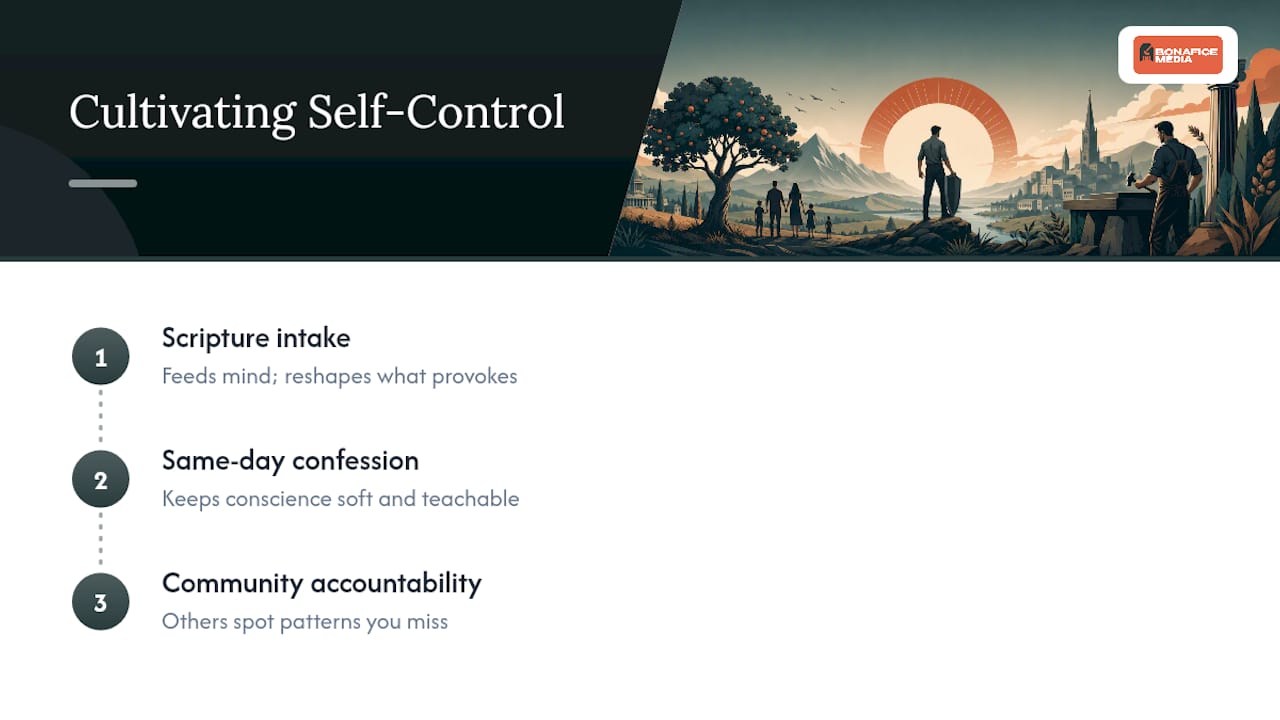
Three concrete practices grow this fruit over time. First, regular Scripture intake, not just for anger verses but for the whole counsel of God, reshapes what you find provoking in the first place. Second, confession, ideally on the same day an angry outburst happens rather than let the guilt calcify, keeps your conscience soft and teachable. Third, community accountability, whether a spouse, an elder, or a small group who has permission to ask hard questions, catches patterns you cannot see in yourself.
Christian counseling for anger often works precisely at this intersection, helping believers connect clinical behavioral strategies to this Spirit-empowered growth rather than treating self-control as a purely psychological skill to master on your own.
A Note From the Bonafice Media Team
Anger is a heart issue, and hearts change through Scripture, prayer, and the local church, not through a checklist alone. Bonafice Media's growing library of teaching series and family discipleship resources exists to support that slower work between counseling sessions and Sunday mornings, never to replace either one.
— The Bonafice Media Team
A Christ-Centered Resource to Support Your Discipleship
A curated Christian streaming library beats a general-market app for this exact reason: every teaching series, family video, and children's program on Bonafice Media has already been checked against Scripture, so you are not sorting through prosperity-gospel content or secular noise while trying to build a habit of self-control.

Bonafice Media's library includes theology-focused teaching series, family discipleship videos, and educational material well suited to reinforcing what you learn in counseling or from your own study of anger and self-control. It runs alongside pastoral care and Christian counseling, not instead of it. Subscriptions are available monthly or annually, with apps designed to support convenient streaming on various devices. For a short devotional companion on staying steady under pressure, see this piece on guarding your faith under strain.
Visit the Bonafice Media app today to start a subscription and add a Christ-centered teaching library to your household's daily discipleship rhythm.
Sources
This article was created with AI assistance under human direction and review. Bonafice Media uses AI as a tool to be faithfully stewarded, never as a substitute for human judgment, study, creativity, or responsibility. Content is reviewed for accuracy, biblical faithfulness, and clarity before publication. Scripture references use the Legacy Standard Bible as applicable. It's for general educational and informational purposes only and is not professional, legal, financial, or pastoral advice.